

I’ve been co-editing Explorations in Economic History for a year now (with my excellent colleague Brian Beach). Editing a journal teaches one a lot about the profession; I’ve learnt a huge amount from the process, and thought I’d share some of the lessons.
There is a lot wrong with academic publishing, and as an author I’ve experienced many of these problems (waiting 18 months on a first decision at a journal when my coauthor and I were untenured assistant professors, for example). But there is also a tremendous amount of unpaid volunteer work that goes on behind the scenes, and as editor I am most appreciative of the work of the excellent referees. Explorations is very lucky to draw on a hard-working, responsive, and very knowledgeable referee pool. Obviously there have been frustrations, but overall I was actually surprised by how many referees get their reports in on time (and by the very high quality of the vast majority of them).
There are also well-known issues with for-profit publishers. My own (previous) employer, George Mason University, stopped subscribing to Explorations last year.
Before proceeding, it is worth reviewing the statistics. Even a small field journal like Explorations gets hundreds of submissions a year. I’ve dealt with about 200 papers since July 2025. This is partly because we don’t have a submission fee, unlike many journals, but it also reflects the sheer increase in the number of papers that are being written.
There is no way that, as a journal, we could publish more than a fraction of these, and our submission stats reflect this. One thing the previous editorial team (Karen Clay and Ralf Meisenzahl) taught me was the importance of respecting and conserving the pool of referees. You can perhaps ask someone to referee a couple of times a year for a journal, but you certainly can’t tax them to write a referee report every other month! So I have tried to be efficient with desk rejections.
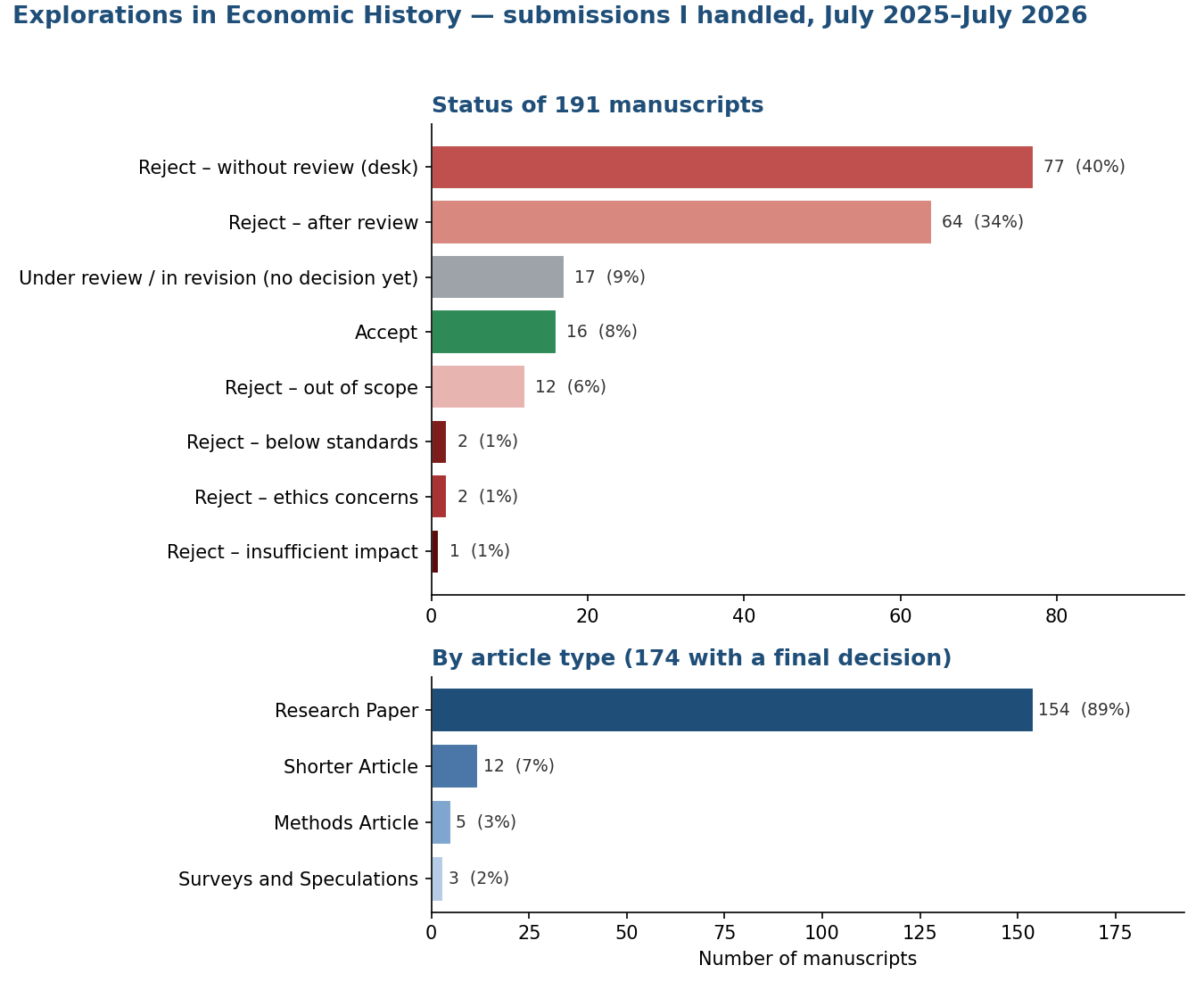
Obviously it is never nice to have a paper rejected. I’ve published around 40 peer-reviewed papers, and the vast majority of those were rejected multiple times (I’ve stopped counting, but I am sure some papers were rejected around 8–10 times prior to finding a home). The best thing one can do is reject papers quickly and efficiently if they are not a good fit. Sometimes this means one-line rejections; in other cases I take the time to try to provide useful feedback. Some of this information is worth sharing.
So what do successful papers at Explorations have in common? The first thing that stands out is that they know the journal they are submitting to. Most papers that are submitted have cover letters announcing that the paper is a great fit for the journal. Unfortunately, often this is untrue. Sometimes this is obvious: we get papers on export growth in the 2010s, or on AI and the future of the global economy. In other cases, we get papers based on detailed archival work or qualitative sources. These papers may or may not be valuable contributions, but they are obviously not what we publish. I think part of the problem here is that paywalls make it difficult for some scholars to actually see what current papers in economic history look like. In contrast, successful papers know that Explorations publishes quantitative papers that address active questions in economic history. They speak to ongoing research questions and engage with the scholarship of other established scholars. These papers are successful because of their scholarly contribution, but they are also relatively easy for me to edit because it is clear who I should ask to referee them.
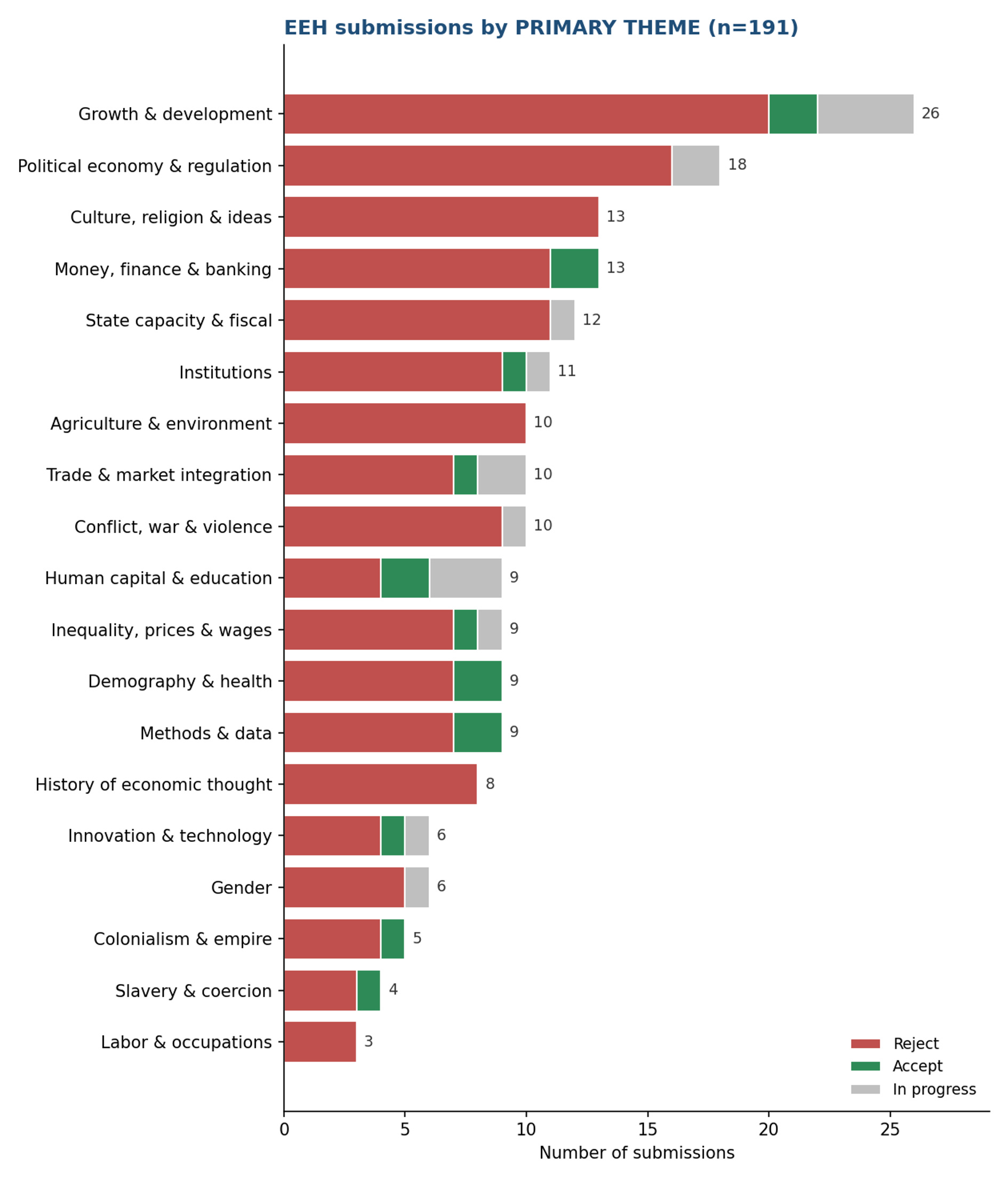
Below I break down papers that I handled between July 2025 and today based on theme. There isn’t too much one should draw from this but I do want to draw attention to one thing. 100% of papers on History of Economic Thought were rejected. History of thought is its own sub-discipline and has its own field journals.
Modern applied papers in economics also share a common language and a common set of standards when it comes to applied work. So the majority (though by no means all) of published papers draw on this toolkit. A common language for statistical and econometric work is very valuable, and means that we can efficiently diagnose problems in research design (e.g. weak instruments or exclusion-restriction issues in an IV design, or pre-trends in a difference-in-differences design). Papers that don’t speak this language can still be published (and are), but they are harder for referees and editors to assess.
Journals are a form of scientific communication. They are part of a modern version of what Joel Mokyr terms the Republic of Letters. So it is vital to learn how to speak this language if one wants to get one’s ideas across. Naturally, however, this means it is difficult for outsiders. It is clear from the submissions I get that authors from outside academia, or from outside Western Europe and North America, find it harder to get published. This, however, is not a problem that I think the editor of a journal can do too much to address (apart from providing useful feedback). What is great is that knowledge of modern econometrics methods is more widely and easily available than at any time in the past.
As a checklist for prospective authors I can only make the following suggestions:
Read, or at least skim, the abstracts of a couple of issues of the journal you are sending your paper to. If your paper isn’t like any of the other recent papers there, it is unlikely to be a good fit.
Think hard about who a good referee for your paper is (and why they are good referees). Make it clear that they are your natural interlocutors, and the editor will likely select at least one of them as a possible referee.
Write a clear and compelling introduction. This is the part of the paper the editor will read most carefully before deciding whether to send it out for review. A few pointers here. Abstracts should be short and to the point. Some journals insist on 150 or 200 words, which is going too far, but I have had some submissions to Explorations with abstracts that run onto the next page, and that defeats the purpose of an abstract. The introduction itself should make it crystal clear what historical puzzle or question the paper addresses, and what methods and data it uses to answer that question.
Finally, field journals play a very different role in the profession than general-interest journals. It is tricky publishing economic history in the top general-interest journals, as one has to make the case that either using historical data or revisiting some old historical questions has important repercussions that regular economists should pay attention to. I welcome the renewed (post-2010) interest in economic history shown by the top journals, but it has also created certain incentives. For a field journal like Explorations, by contrast, many successful papers address themselves to quite narrow questions. Answering a small question well, or with new data or methods, is likely sufficient. Conversely, more ambitious papers about long-run persistence or big issues in development sometimes get rejected by our referees because they get crucial details about the data or the history wrong.
Brian and I are committed to making Explorations the premier field journal in which to publish research in economic history, especially of a more quantitative variety (though we also wish our friends and colleagues editing the Journal of Economic History well!).