

I was recently asked to write about Degrowth for Cato’s Human Progress Substack. See below for the full article.

My piece makes it clear that we shouldn’t be taking degrowth very seriously, at least as scholarship, though we might have to start taking it seriously as advocacy.
Here it might be worth going into a little bit more detail on the economic history behind the article. To do this we need to tackle a piece published in World Development by Dylan Sullivan and Jason Hickel entitled “Capitalism and extreme poverty: A global analysis of real wages, human height, and mortality since the long 16th century”. This article is influential; as of now it has 181 citations despite being published just three years ago and it is the main basis for many of the claims Hickel makes in his more popular books. This is an effective polemic but not a serious piece of scholarship.
Let us see why.
Sullivan and Hickel set out to overturn what they call “the standard public narrative”: the claim, associated with Steven Pinker and Hans Rosling - and indeed one Jared Rubin and I use in How the World Became Rich - that around 90 percent of humanity lived in extreme poverty before 1800 and that capitalism was then responsible for lifting the majority of the world’s population out of destitution.
Instead, they draw on data on real wages, adult male height, and mortality. Their big claim is that the rise of capitalism from 1500 onwards caused a “dramatic deterioration” in human welfare. And improvement, where it came, arrived only in the 1880s in northwest Europe and the mid-twentieth century elsewhere, driven by organized labour and the public provision of goods like healthcare and welfare rather than by growth.
The claim that the onset of capitalism coincided with a decline in living standards rests on the following evidence.
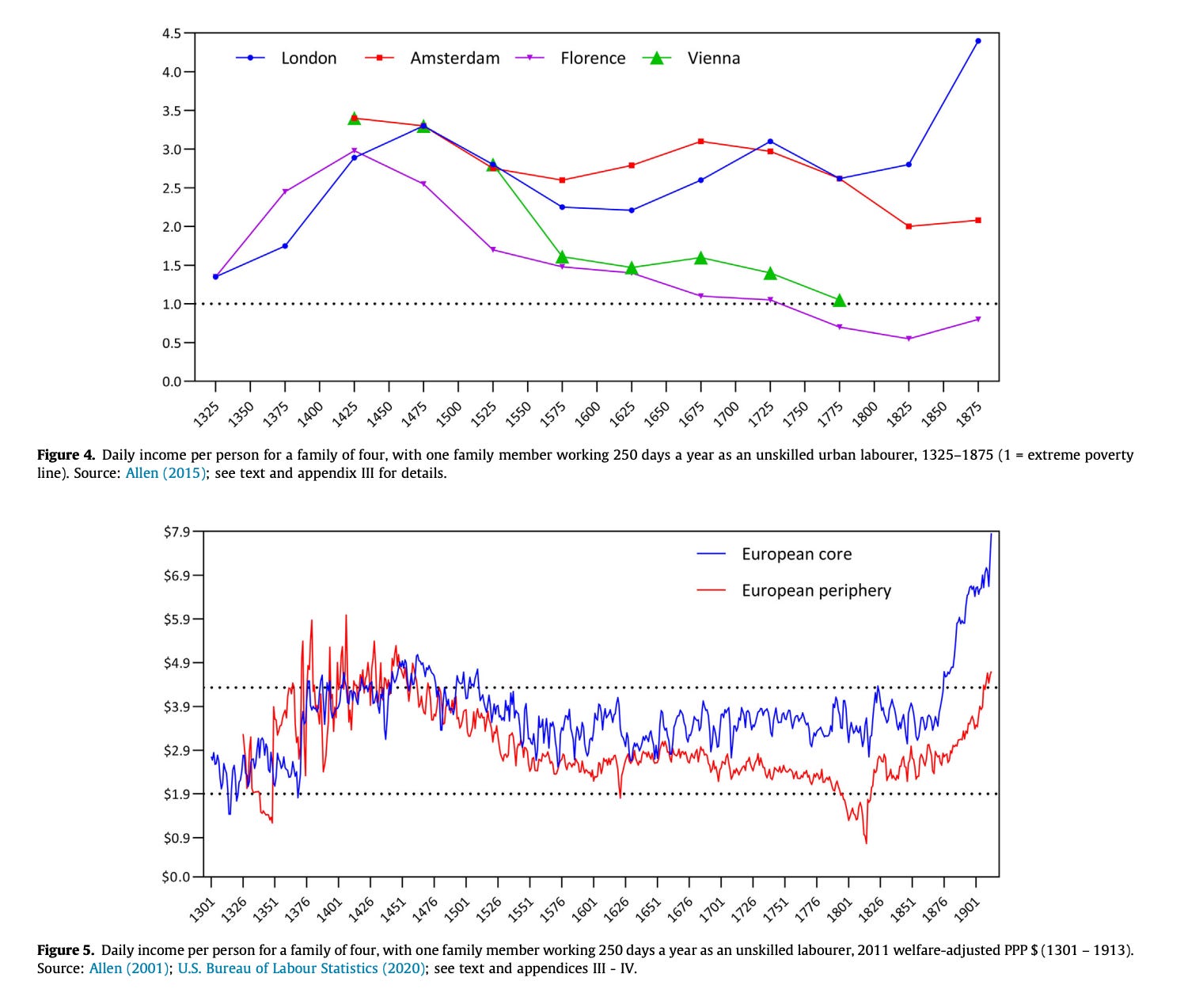
This data rests on the work of Robert Allen and is extremely well-known among economic historians and other social scientists. They were first published in 2001 and that paper (published in Explorations in Economic History, no less) has 1982 citations on Google Scholar. The finding that real wages declined during the early modern period is not quite the gotcha that Sullivan and Hickel seem to think. Economic historians have known this at least since the work of Wilhelm Abel whose Agricultural Fluctuations in Europe came out in German in 1935. Henry Kamen’s The Iron Century was premised on the idea that the period 1550-1660 was one of falling living standards across continental Europe.
The issue then is not with the facts but with their interpretation. I will point out that Sullivan and Hickel cite Allen’s 2015 paper entitled "The high wage economy and the industrial revolution: a restatement". The whole point of this paper is for Allen to defend his high estimates for British wages and to argue that these high wages as partly a product of Britain’s market economy and colonial expansion. So it is curious to see this as evidence that the alleged onset of capitalism lowered real wages. But this is a side point.
The real point is that the pattern of falling real wages in Figure 4 of Hickel and Sullivan is entirely an artifact of the Black Death. Note that there are only two cities for which there is data before 1425 (London and Florence).1 London’s estimate for the 1st half of the 14th century is the lowest value London records in the entire five and a half centuries of the series. The fall in living standards Hickel and Sullivan record is simply the demographic recovery from the Black Death in a largely Malthusian world.
We can use Allen’s own data to extend the data for London back to the 13th century and it becomes very clear that the post-Black Death spike in real wages is the outlier and that living standards were not high in the bucolic preindustrial age. The usual caveats apply as English population estimates for the pre-Black Death era are disputed.
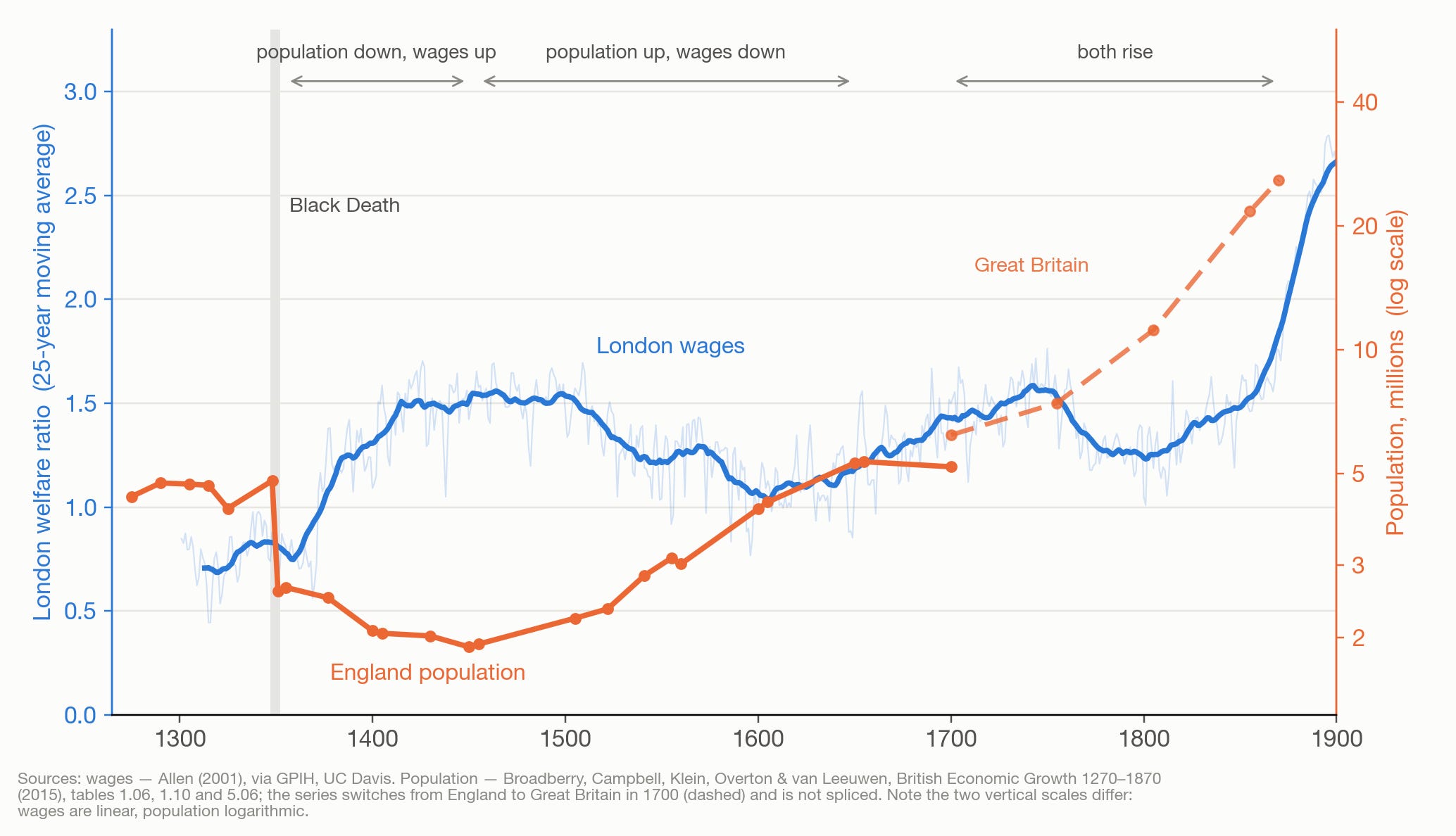
Their argument rests on the claim that the onset of capitalism was in 1500 which also happens to be the point when Europe’s demographic recovery really began to gain momentum and its population began again to exert pressure on land and resources. What if is said to have capitalism begun in 1750 or 1800? The argument collapses. Similarly, if capitalism is dated to 1300 then should we say it caused a big rise in real wages (followed by a fall)? Any argument from timing is both unserious and fragile.
What about arguments from location? The fall in real wages was real and prolonged in Southern Europe. This is the standard story of a Little Divergence within Europe. But this interpretation seems to be the opposite of Sullivan and Hickel’s story. Where capitalism is getting going - London and Amsterdam - real wages go up, but where older feudal institutions remained, or in areas left out of the Atlantic trade boom there is stagnation.
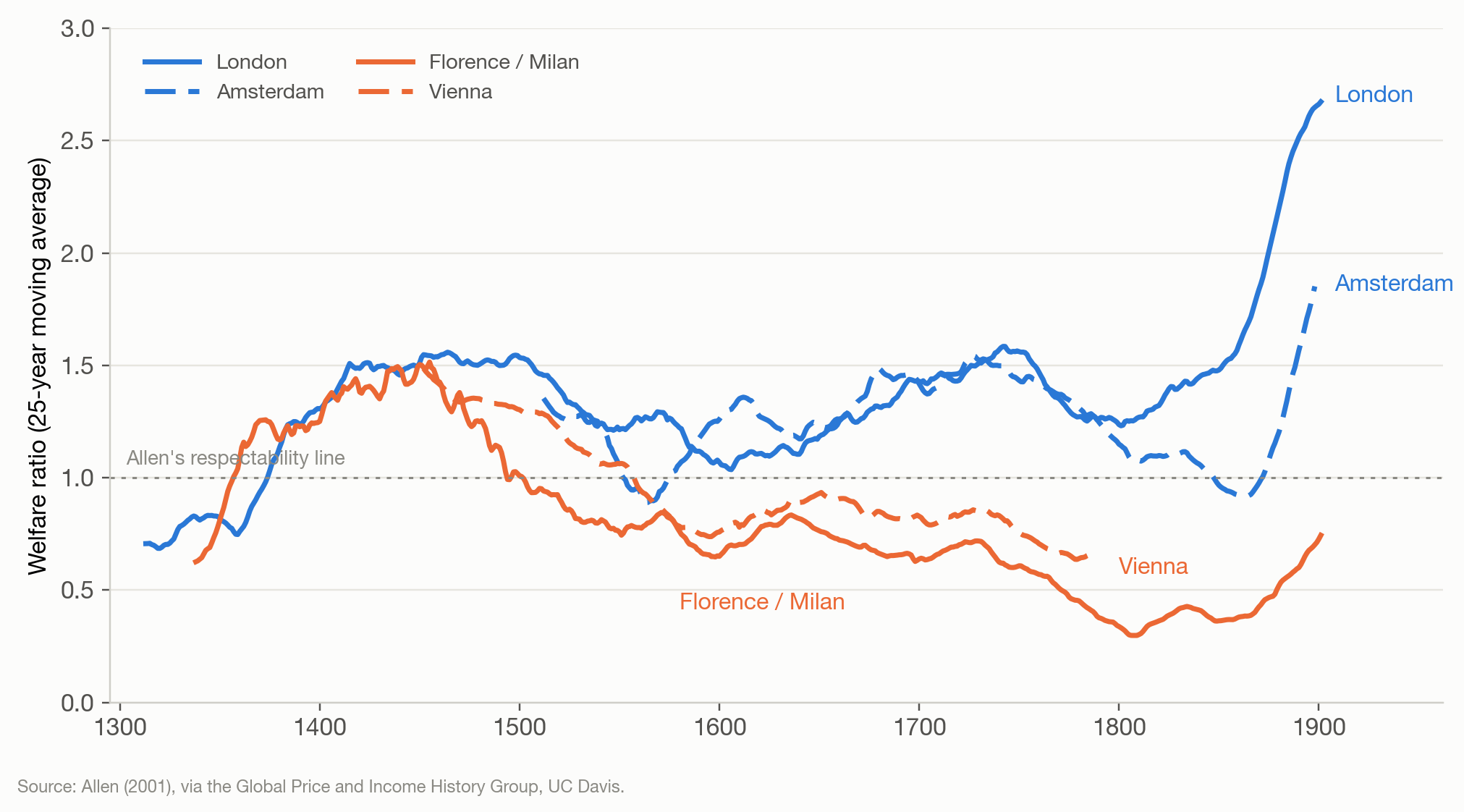
None of this is definite and there are a lot more things one could go into but this alone undercuts the entire narrative thrust Hickel then refers to and builds upon in his popular books such as Less is More.2
The Florence series is actually an interpolation of Florence and Milan, so it cannot be relied upon.
What is more Sullivan and Hickel more or less acknowledge their interpretation of this data contradicts that of anyone who has worked in the field when they note that
“. . . many of the scholars we rely on for data attribute the trends outlined here not to the rise of capitalism, but to Malthusian population dynamics... Yet they ignore how these dynamics are themselves structured by the politico-economic system."
A comment that is somewhat question-begging.
I'm very happy to see you tackle this topic and the Hickel-Sullivan paper! I wrote a long peer-reviewed response along the lines you take, with some additional data that H&S conveniently left out (though it was available to them). I cited some of your work there as well. :)
I hope plugging the paper isn't disrespectful, here's the full open access version: https://www.tandfonline.com/doi/full/10.1080/03906701.2024.2380314
And a brief summary if people don't want to read the article: https://statsandsociety.substack.com/p/extreme-poverty-before-capitalism
I have not read the book, but I have a hard time understanding how the author can claim that wages in Early Modern Europe provides a solid justification for Degrowth.
The dramatic increase in per capita GDP since them seems to justify the opposite.