

Nick Craft was a giant in British economic history. He sadly passed away in 2023. I reviewed one of his last books, Forging ahead, falling behind and fighting back, when it came out in 2018 for the Economic History Review.
I decided to post my short review of it below as it is otherwise hard to access and behind a paywall. I’d love to write a longer piece if I had time. By way of introduction, I should note that I have been listening to Dominic Sandbrook’s masterful books on the 1970s (in reverse chronological order).
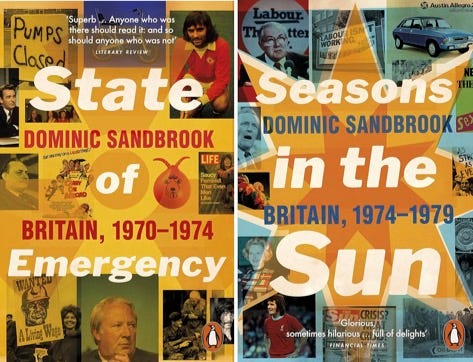
What I appreciate about Sandbook’s account of Britain is that he understands the particular economic situation facing British policymakers in the 1970s. From 1945 through to the early 1970s growth had appeared robust and indeed historically unprecedented. But at the same time, it was precisely in these decades that the British economy became uncompetitive and was overtaken by its European peers. Nick Craft’s research is the best place to start if one wants to understand why.
Forging ahead, falling behind and fighting back
Forging ahead, falling behind and fighting back
Why was Britain the first industrial nation? Why was it eventually caught up? Why once it had fallen behind the United States, did it fall further behind its European rivals in the Post-War period? And how did it recover its relative position in the 1980s and 1990s? Forging ahead, falling behind and fighting back provides a macroeconomic perspective on the these questions. The word macro is advisory. Crafts surveys the British economy from 1000 feet, through the lens of growth theory. The upside is that he delivers a lot of insight in 150 pages.
The first chapter provides an overview of the Crafts-Harley view of the British Industrial Revolution. This emphasizes its limited scope. On the eve of the Industrial Revolution, the British economy already had a comparatively modern structure, with many individuals working outside agriculture. Growth between 1770 and 1850 was reliant on a few key sectors and TFP growth was modest (0.4% a year). Most workers remained employed in traditional sectors of the economy. Not until the second-half of the 19th century did the benefits of steam, the general purpose technology of the age, fully diffuse through the economy. Nonetheless, from a long-run perspective, the achievements of this period, modest but sustained increases in per capita GDP despite rapid population growth, were indeed revolutionary.
One theme of the book is institutional path dependency. Characteristics of Britain’s early position as an industrial leader continued to shape its political economy until the end of the 20th century. For instance, Britain’s precocious reliance on food imports from the early 19th century onwards left a legacy that was favorable to free trade. Elsewhere, democratization in the late 19th century often led to protectionism, but in Britain it solidified support for free trade because, after the expansion of the franchise, the median voter was an urban worker dependent on imported bread.
The second part of book considers the late Victorian, Edwardian, and inter-war periods. In the late 19th century the United States overtook Britain. A venerable scholarship has identified this period as one of economic failure. Crafts, however, largely follows McCloskey in exonerating Edwardian Britain from the charge of economic failure. Competition limited managerial inefficiencies in most areas of the economy; though there were notable failures in sectors where competition was limited such as the railways. The main policies failures were this ones of omission rather than commission: more could have been done to invest in R&D and support basic science.
The seeds of failure, for Crafts, were sown in the interwar period. Place in a comparative light, TFP growth in the interwar period was significantly slower than in the US. The new industries of this period did not establish a strong export position. The 1930s saw the establishment of a managed economy, in which policymakers acceded to a marked decline in market competition. Protectionism and cartelization kept profits high but at a cost of long-run productivity growth that would only be fully revealed after 1945.
Most economic historians view the postwar period through the lens of Les Trente Glorieuses. But in Britain this was an era of missed opportunities. Growth accounting suggests that Britain underperformed relative to its European peers. Thus though the British economy grew faster in these years than in any other period, it is in this period that Britain’s relative failure should be located.
Crafts examines this failure using insights from the varieties of capitalism literature, which contrasts coordinated market economies like West Germany with liberal market economies like the United States or Britain. In the favorable conditions of postwar recovery and growth, coordinated market economies saw high investment and wage restraint. Britain, however, lacked the corporatist trade unions of West Germany. As a legacy of the Industrial Revolution, it inherited a diverse set of overlapping craft unions which could not internalize the benefits of wage restraint and often opposed new technologies or managerial techniques. Britain functioned as a dysfunctional liberal market economy, one that became increasingly sclerotic as the 1960s passed into the 1970s.
Industrial policy was meant to “pick winners’”. But “it was losers like Rolls Royce, British Leyland and Alfred Herbert who picked Minsters” (p. 91). Market power grew. Approximately 1/3 of the British economy in the 1950s was cartelized and 3/4 saw some level of price fixing. Britain’s exclusion from the EEC until the 1970s meant that protective barriers were high, enabling inefficient firms and managerial practices to survive. High marginal rates of taxation and weak corporate governance encouraged managers to take their salaries in the form of in-kind benefits, and deterred innovation. Labour relations became increasingly hostile as the external economic environment worsened following the end of Bretton Woods.
Britain recovered its relative economic position after 1979 through radical economic reforms and a dramatic shift in policy objectives. Though of course, the Thatcher period saw numerous missteps and policy blunders, what Crafts argues was most important was that there was an increase in product market competition, a reduction in market distortions, and trade union power, factors that enabled Britain to benefit from the ICT revolution in the 1990s.
Rarely does one wish a book to be longer. But this is the case with Forging Ahead, Falling Behind, and Fighting Back. While a short and sharp overview of the Industrial Revolution is entirely appropriate, given the number of pages written on this topic, the last part of the book does need extra pages; the argument there is too brief and requires more evidence and substantive argumentation. One wishes, for instance, that the theme of institutional path dependency was developed in more detail. Despite this, Forging Ahead, Falling Behind, and Fighting Back is a notable achievement. It provides a masterly survey of British economy history tied together by insights from economic theory.