

This is an old post of mine (originally here). I think it is of interest so am republishing it with minor edits for typos and flow.
On Branko Milanovic’s recommendation, I read Aldo Schiavone’s The End of the Past. Scholarly and elegantly written, it provides one of the best imaginative reconstructions of the ancient Roman economy.
Previous posts have touched on the economies of late antiquity, the modernist primitivist debate, and diagnosed problems in many recent assessments of the ancient economy (here, and here). I want to use Schiavone’s book to revisit a question raised by Peter Temin in The Roman Market Economy. How advanced was the Roman economy? Specifically, how did it compare to the economy of Europe in late medieval or early modern times? Was the Roman economy only as developed as that of Europe circa 1300 or was it as advanced as that of western Europe on the eve of the Industrial Revolution in say 1700.
This question is not mere idle speculation. It matters for our understanding of the causes of long-run economic growth whether an industrial revolution could have happened in Song China or ancient Rome. This type of counterfactual history is crucial for pinning down the causal mechanisms responsible for sustained growth, especially as historians like Bas van Bavel are now proposing explicitly cyclical accounts of growth in societies as varied as early medieval Iraq and the Dutch Republic (see The Invisible Hand? (OUP, 2016))
Temin’s GDP estimates suggest that Roman Italy had comparable per capita income to the Dutch Republic in 1600. The Empire as a whole, he suggests, may have been comparable to Europe in 1700 (Temin 2013, 261). My gut reaction is that this is plausible as an upper-bound. Schiavone (writing several years before Temin), however, raises important points that I had not fully considered previously.
Schiavone opens with an account of a speech given by Aelius Aristides celebrating the wealth of the Roman empire in the mid-2nd century AD.
“Whatever each culture grows and manufactures cannot fail to be here at all times and in great profusion. Here merchant vessels arrive carrying these many commodities from every region in every season and even at every equinox, so that the city takes on the appearance of a sort of common market for the world. One can see cargoes from India and even from southern Arabia in such numbers that one must conclude that the trees in those lands have been stripped bare, and if the inhabitants of those lands need anything, they must come here to beg for a share of what they have produced….
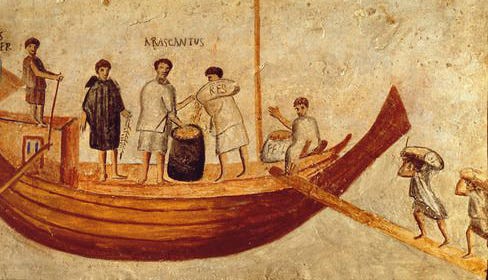
Your farmlands are Egypt, Sicily, and all of cultivated Africa. Seaborne arrivals and departures are ceaseless, to the point that the wonder is, not so much that the harbor has insufficient space for all these merchant vessels, but that the sea has enough space (if it really does). Just as there is a common channel where all waters of the Ocean have a single source and destination, so that there is a common channel to Rome and all meet here: trade, shipping, agriculture, metallurgy— all the arts and crafts that are or ever were and all things that are produced or spring from the earth. What one does not see here does not exist” (Aristides, The Roman Oration).
This is a panegyric addressed to flatter the emperor but its emphasis on long-distance trade, commerce, manufacturing is highly suggestive. Such a speech is all but impossible to imagine in a predominantly rural and autarkic society. Aristides is painting a picture of a highly developed commercialized economy that linked together the entire Mediterranean and beyond. Even if he grossly exaggerates, the image he depicts must have been plausible to his audience. In evaluating the Roman economy in the age of Aristides, Schiavone notes that:
“Until at least mid-seventeenth century Amsterdam, so expertly described by Simon Schama — the city of Rembrandt, Spinoza, and the great sea-trade companies, the product of the Dutch miracle and the first real “globalization of the economy — or at least, until the Spanish empire of Philip II, the total wealth accumulated and produced in the various regions of Europe reached levels that were not too far from those of the ancient world” (Schiavone, 2000, 94).
This is the point Temin makes. Whether measured in terms of the size of its largest cities — Rome in 100 AD was larger than any European city in 1700 — or in the volume of grain, wine, and olive oil imported into Italy, the scale of the Roman economy was vast by any premodern standard. Quantitatively, then, the Roman economy looks as large and prosperous as that of the early modern European economy.
Qualitatively, however, there are important differences that Schiavone draws out and which have been obscured in recent quantitative debates about GDP estimates.
Observe that Roman history leaves no traces of great mercantile companies like the Bardi, the Peruzzi or the Medici. There are no records of commercial manuals of the sort that are abundant from Renaissance Italy; no evidence of “class-struggle” as we have from late medieval Europe; and no political economy or “economics”, that is, no attempts to systematize one’s thoughts and insights concerning the commercial world. The ancient world, in this view, only superficially resembled that of early modern Europe. Seen from this perspective, the latter contained the potential for sustained growth; the former did not. Why is this?
The most obvious institutional difference between the ancient world and the modern was slavery. Recently historians have tried to elevate slavery and labor coercion as crucial causal mechanisms in explaining the industrial revolution. These attempts are unconvincing (see this post) but slavery certainly did dominate the ancient economy.
In its attempt to draw together the various strands through which slavery permeated the ancient economy, Schiavone’s chapter “Slaves, Nature, Machines” is a tour de force. At once he captures the ubiquity of slavery in the ancient economy, its unremitting brutality—for instance, private firms that specialized in branding, retrieving, and punishing runaway slaves — and, at the same time, touches the central economic questions raised by ancient slavery: to what extent was slavery crucial to the economic expansion of the period between 200 BCE and 150 AD? And did the prevalence of slavery impede innovation?
It is impossible to do justice to the argument in a single post. Suffice to say that after much discussion, and many fascinating interludes, Schiavone suggests that ultimately the economic stagnation of the ancient world was due to a peculiar equilibrium that centered around slavery.
One can think of this equilibrium as resting on two legs. The first is the observation that the apparent modernity of the ancient economy — its manufacturing, trade, and commerce — rested largely on slave labor. The expansion of trade and commerce in the Mediterranean after 200 BC both rested on, and drove, the expansion of slavery. Here Schiavone notes that the ancient reliance on slaves as human automatons — machines with souls — removed or at least weakened the incentive to develop machines for productive purposes.
The existence of slavery, however, was not the only reason for the neglect of productive innovation. There was also a specific cultural attitude that formed the second leg of the equilibrium:
“None of the great engineers and architects, none of the incomparable builders of bridges, roads, and aqueducts, none of the experts in the employment of the apparatus of war, and none of their customers, either in the public administration or in the large landowning families, understood that the most advantageous arena for the use and improvement of machines — devices that were either already in use or easily created by association, or that could be designed to meet existing needs — would have been farms and workshops”
The relevance of slavery colored ancient attitudes towards almost all forms of manual work or craftsmanship. The dominant cultural meme was as follows: since such work was usually done by the unfree, it must be lowly, dirty and demeaning:
“technology, cooperative production, the various kinds of manual labor that were different from the solitary exertion of the peasants on his land — could not but end up socially and intellectually abandoned to the lowliest members of the community, in direct contact with the exploitation of the slaves, for whom the necessity and demand increased out of all proportion . . . the labor of slaves was in symmetry with and concealed behind (so to speak) the freedom of the aristocratic thought, while this in turn was in symmetry with the flight from a mechanical and quantitative vision of nature”
Thus this attitude also manifested itself in the disdain the ancients had for practical mechanics.
Similar condescension was shown to small businessmen and to most trade (only truly large-scale trade was free from this taint). The ancient world does not seem to have produced self-reproducing mercantile elites. Plausibly this was in part because of the cultural dominance of the landowning aristocracy.
The phenomenon coined by Fernand Braudel, the “Betrayal of the Bourgeois,” was particularly powerful in ancient Rome. Great merchants flourished, but “in order to be truly valued, they eventually had to become rentiers, as Cicero affirmed without hesitation: ‘Nay, it even seems to deserve the highest respect, if those who are engaged in it [trade], satiated, or rather, I should say, satisfied with the fortunes they have made, make their way from port to a country estate, as they have often made it from the sea into port. But of all the occupations by which gain is secured, none is better than agriculture, none more delightful, none more becoming to a freeman’” (Schiavone, 2000, 103).
Such a cultural argument fits perfectly with Deirdre McCloskey’s claim in her recent trilogy that it was the adoption of bourgeois cultural norms and specifically bourgeois rhetoric that distinguished and caused the rise of north-western Europe after 1650.
Having taken note of the existence of such a powerful equilibrium — one resting on both material and cultural foundations — we can now return to Schiavone’s argument for why a modern capitalist economy did not develop in antiquity. He argues that given the prominence of slavery and the prestige of the landowning elite, economic expansion and growth of the kind that took place between c. 200 BCE to 150 CE was not self-reinforcing. It generated a growth efflorescence that lasted several centuries, but it ultimately undermined itself because it was based on an intensification of the slave economy that, in turn, reinforced the cultural supremacy of the landowning aristocracy and this cultural supremacy in turn eroded the incentives responsible for driving growth.
Compare and contrast with early modern Europe. The most advanced economies of early modern Europe, say England in 1700, were on the surface not too dissimilar to that of ancient Rome. But beneath the surface they contained the “coiled spring”, or at least the possibility, of sustained economic growth — growth driven by the emergence of innovation (a culture of improvement) and a commercial or even capitalist culture. According to Schiavone’s assessment, the Roman economy at least by 100 CE contained no such coiled spring.
We are not yet at the point when we can decisively assess this argument. But the importance of culture and the manner in which cultural and material factors interacted is clearly crucial. The argument that the slave economy and the easy assumptions of aristocratic superiority reinforced one another is a powerful one. For whatever historical reasons these cultural elements in the Roman economy were relatively undisturbed by the rise of merchants, traders and money-grubbing equites. Likewise slavery did not undermine itself and give rise to wage labor.
Why this was the case can be left to future analysis. The full answer to the question why this was the case and a more careful consideration of the counterfactual “could it have been otherwise” are topics deserving their own blog post.
First - for most of history land was by far the best investment - good returns, least risk. It was also the scene of continuous improvements in Roman times: new crops, better animals, new techniques and so on. Plus, for much of the time, prospect for expansion (both Roman and medieval landowners invested in clearing land, draining marshes and finding better uses for marginal lands). So a preference for land is quite understandable - the richest people in mid-Victorian Britain were the great landowners, on the back of leaps in productivity. It was far more than a passive investment.
Second - wealth is not understanding, or even a considerable enabler of understanding. The Romans lacked most of the necessary tools and understandings to advance industrially. In fact they lacked the tools to make the tools, and the materials to make the tools to make the tools. Mere money could not make up this lack.
Lastly, slavery played a major role until quite modern times, contributing significantly to the wealth of Amsterdam, London and Paris. Nor was it absent in medieval times: around 10% of the population of England in the 11th century were slaves, and it figures heavily in the mercantile republics of Italy.
Cicero's advice that successful merchants should cash out into land, that trade is only respectable once you've left it, isn't a cultural preference. It's a compulsion: to be recognised as a man of standing, you had to convert. Not doing so signals political exclusion, not just cultural disdain.
The Roman landowning aristocracy was politically unchallenged, so its disdain for trade was a status assertion that worked. It carried coercive force. Where merchants did sit inside the constitutional settlement, as in England and the Dutch Republic, the disdain lost that force, and the rhetoric of the bourgeoisie became possible.
McCloskey's point is precisely this: bourgeois rhetoric required constitutional standing, the kind that made status conversion optional rather than compulsory. Roman merchants had wealth but not that standing.
On that basis, aristocratic disdain for trade wasn't a free-standing cultural fact — it was produced by the underlying political settlement, a symptom of who held power (and wanted to preserve it), rather than a cause in its own right.
It's worth asking, then, whether Schiavone's equilibrium is truly cultural. Or maybe the cultural story is downstream of a simpler political fact: merchants who can't challenge aristocratic power have no choice but to imitate it.