

Tyler Cowen famously coined the term state capacity libertarianism. The concept has become influential among those who see a capable state that can enforce general rules and secure basic public goods as a precondition for free markets to flourish. Philosopher Billy Christmas has introduced the term state capacity liberalism to argue that liberals of all stripes should take the concept of state capacity seriously. As he puts it:
“State capacity liberals believe that if we care about liberal society we should care about understanding and sustaining the seemingly paradoxical, and certainly contingent, equilibrium that generates it” (Christmas, 2026).
I think this is an important intellectual development and urge you to read the full paper. In this series of short posts, I want to suggest 19th-century Prussia as a possible example or case study for state capacity liberalism in practice.
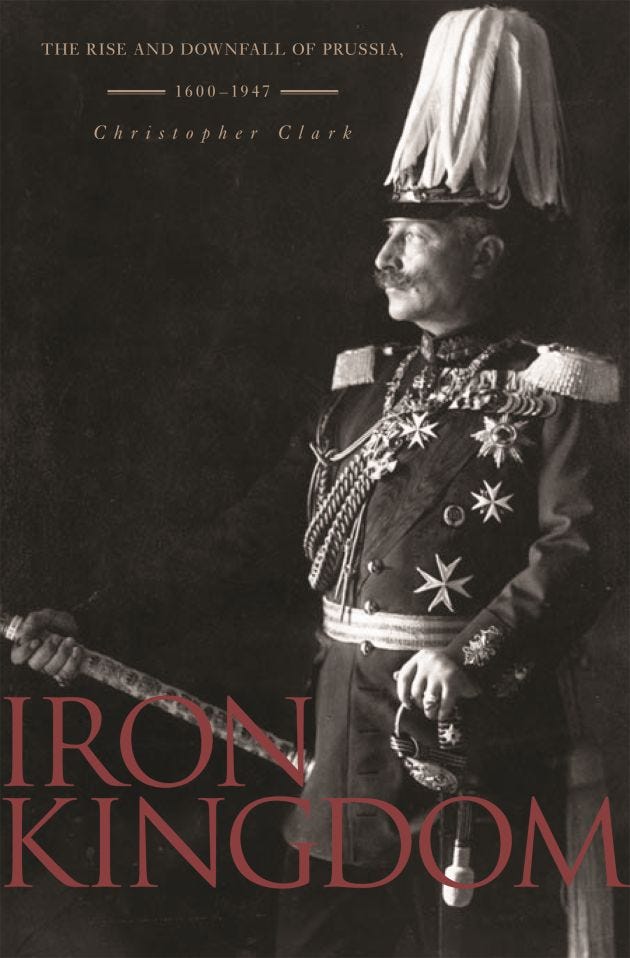
Much of what I sketch below relies on Christopher Clark’s excellent Iron Kingdom: The Rise and Downfall of Prussia, 1600–1947.
This first part of the essay will consider whether the development of a powerful state in Prussia led to the formation of a particularly harsh despotism or rather prefigured the rise of a genuinely liberal state. The second part will apply the framework of identity rules versus general rules to the legal reforms undertaken in the 18th and 19th centuries. Finally, the third part of the essay will consider the pro-growth and pro-market effects of state policy in Prussia and the impact on economic growth in Germany.
Prussia as a Despotic Leviathan
For many scholars, Prussia has long been seen as the archetypical illiberal or despotic state. It is the poster-child for what Daron Acemoglu and James Robinson call a “despotic leviathan”. In the account they provide in The Narrow Corridor, Prussia is the quintessential state forged by war. Beginning their account with the Great Elector, Frederick William, who remade the Prussian state and army in the wake of the Thirty Years’ War, they provide a classic account of how war drove state-building.
“This all meant greater state capacity. With big guns, the state could control more. But to get big guns, it needed more tax revenues. More tax revenues would be easier to raise if Frederick William could increase his power over society, and that’s what he did. Previously taxes had to be negotiated with various representative bodies, such as the Estates of Kurmark in Brandenburg. He started out by trying to get permanent grants of taxation, which would free him from the need to endlessly seek the approval of the estates”
Social scientists will recognize this account as classic Tilly: war made the state, and the state made war. Or as Acemoglu and Robinson put it:
“War might have made the state in Prussia, but it made a famously despotic one.”
Liberty, they conclude, was “completely snuffed out.” Here Acemoglu and Robinson are championing a long intellectual tradition, one that goes back at least as far as World War I.
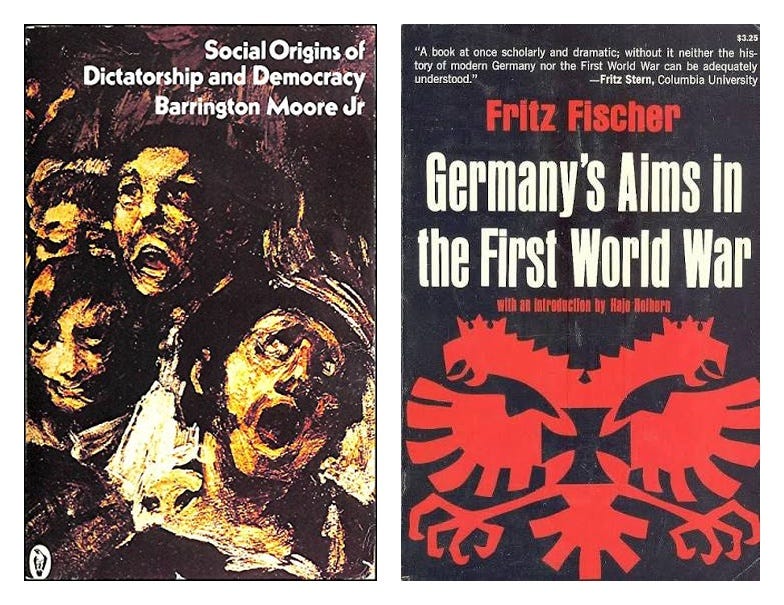
Barrington Moore famously contrasted Prussia’s political development with that of England and France. In Prussia, the power of the landed Junker elite impeded the development of bourgeois and liberal institutions and led Germany onto a perverse and militaristic developmental track. Fritz Fischer’s argument that Germany bore primary responsibility for the outbreak of the First World War helped inspire the famous Sonderweg thesis.
How then could Prussia be an example of any form of “liberalism” let alone state capacity liberalism?
Prussia and the Rule of Law
Acemoglu and Robinson quote the Great Elector and Frederick the Great as seeking to rule despotically:
“The Great Elector himself observed, ‘So long as God gives me breath, I shall assert my rule like a despot . . .’
Frederick the Great agreed, remarking:
‘A well-run government must have a firmly established system . . . in which finance, policy and military all combine to promote the same end, the strengthening of the state and the expansion of its power. Such a system can only derive from one brain.’”
But were absolutistic or despotic aspirations the same as actually being a despot?
There is a longstanding literature that says that for early modern Europe the answer is a pretty definitive no.1
As Peter Wilson puts it:
“Absolutism was once a certainty. It was seen as a distinct form of monarchy that dominated the European continent and defined an entire age . . . ”
He goes on to note that:
“Where are these certainties now? Generations of historians have been chipping away at an edifice which, even if its precise shape was in dispute, at least had seemed solid enough and its basic dimensions agreed by all. The hammers and chisels have been replaced by power tools, and what seemed so imposing has been revealed as nothing more than a stucco façade. As the plaster falls away, the once omnipotent inhabitants of the palace are exposed as frauds who disguised their lack of real power with a lot of showy display. Robbed of their grand coverings, they appear little different from rulers elsewhere in Europe’s history, bound by customary and practical constraints to consult traditional institutions and important social groups.”
Before we go on, it is worth considering the evidence for the Great Elector’s despotism. Effectively, it comes from his successful struggle with the towns and the estates over taxation.
The many self-governing cities such as Königsberg that had inherited rights and autonomy from the Middle Ages were stripped of their independence and subsumed under royal power. Königsberg resisted his demands for taxation outside the Estates and lost.
Many early modern rulers struggled against the independence of local elites, towns, and religious institutions. These struggles were often violent - think of the expulsion of the Huguenots or the Dissolution of the monasteries. One measure of despotism then would be how violent this process of state building was.
As a point of comparison, in his repression of the city of Novgorod, the Russian Tsar Ivan the Terrible killed 2000-3000 people or 10-30% of the population on modern estimates. Many were roasted alive or tortured to death. Following the Pilgrimage of Grace in 1536/7, Henry VIII executed 216 local elites. Some like Robert Aske were hanged in chains, others hanged, drawn and quartered, or like Margaret Cheney burned alive.
So how many people did the Great Elector end up killing in his struggles with towns and estates?
Disappointingly, according to Clark, the Great Elector had one person executed for political crimes across a 46 year reign. He treated his main urban opponent Hieronymus Roth pretty badly - Roth died in prison rather than accede to the Elector’s demands. But put in a comparative historical perspective, this body count makes him almost saintly.
Frederick the Great’s Absolutism
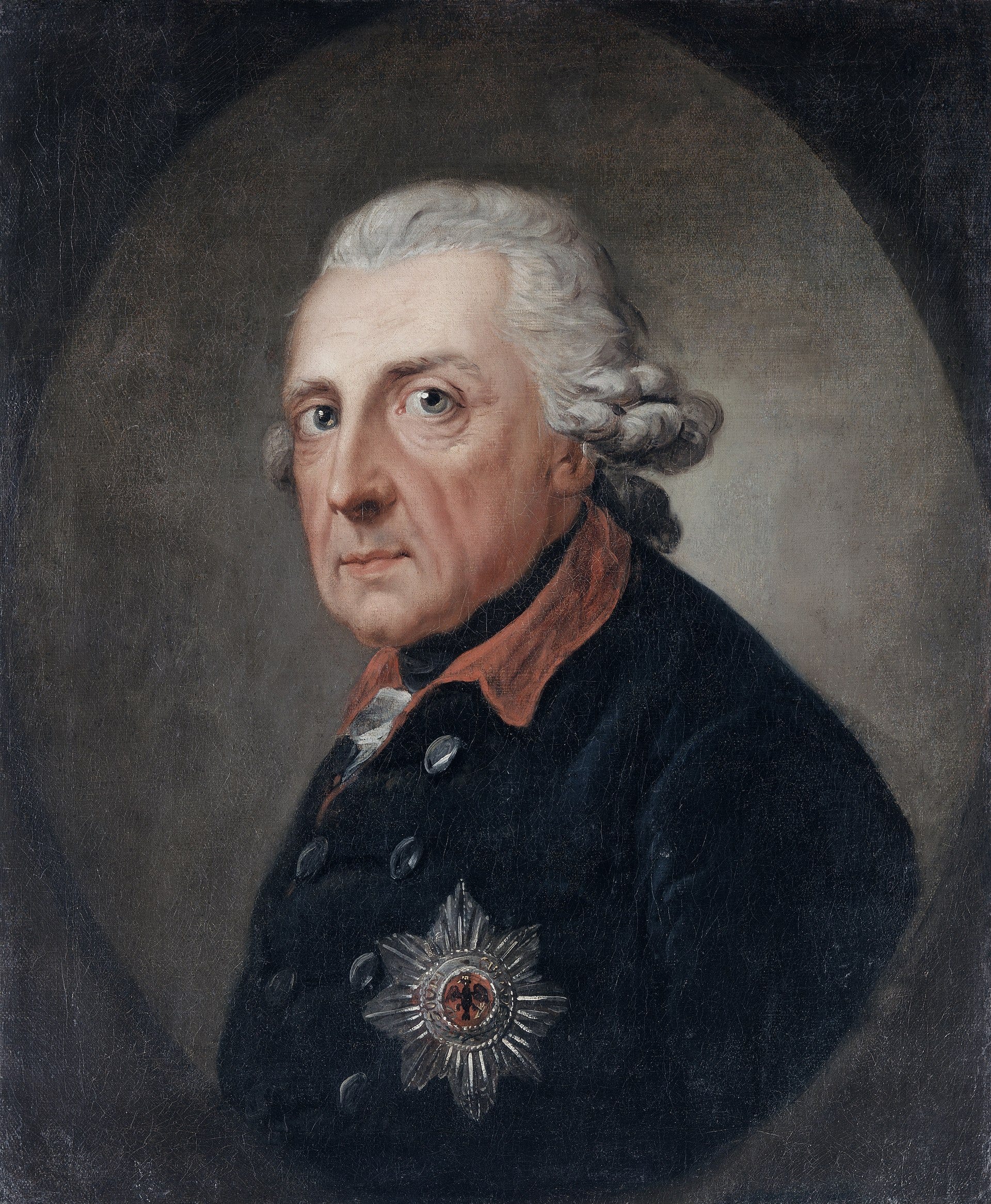
What about his great-grandson Frederick the Great? Frederick was certainly authoritarian and autocratic.
But there is another quite different story told about Frederick the Great. Admittedly the story is apocryphal but the fact that it was told is nonetheless revealing. This is the Legend of the Miller of Sanssouci.
Sanssouci in Potsdam is where Frederick built his summer palace. According to the legend, Frederick was disturbed by the noise made by the windmill and offered to buy it from the miller. The miller refused. Frederick then threatened him:
“Does he not know that I can take the mill away from him by virtue of my royal power without paying one groschen for it?”
The miller is supposed to have replied:
“Of course, your majesty, your majesty could easily do that, if – begging your pardon – it were not for the Supreme Court in Berlin.”
Now, there is no evidence that any of this happened! And the real story of the mill appears to be quite different. Frederick was quite capable of overturning judicial decisions. But it reveals that contemporaries had quite a different view of how despotic Prussia was.
None of this is to downplay the real institutional differences that emerged between England and continental monarchies like Prussia over the course of the 17th and 18th centuries.
But as we will see in the next post, the polity that Frederick the Great built would eventually become a rule of law state capable of unleashing rapid economic growth in the century after his death. We will consider the argument (made previously in work I have done with Noel Johnson) that the early modern state, by breaking down feudal rules and institutions, actually cleared the way for modern liberal institutions. And in so doing, I will call upon the expertise of an unlikely authority.
This is also my main criticism of the 2005 Acemoglu, Johnson and Robinson paper on Atlantic trade and institutional development in Europe.