

My previous post discussed the myth of Prussian despotism. We saw that the claim that the Prussian state extinguished liberty was an exaggeration.
Nonetheless, there is obviously a grain of truth in the view of Prussia as an authoritarian state in the mid-18th century. Frederick the Great was a notorious micromanager. State monopolies were created for goods such as tobacco, coffee, and salt. Frederick anticipated Hamilton’s and List’s notion of infant industries, subsidizing the silk industry in Prussia and linen production in Silesia.
All of this resulted in much waste, goods of inferior quality, and higher prices for consumers.
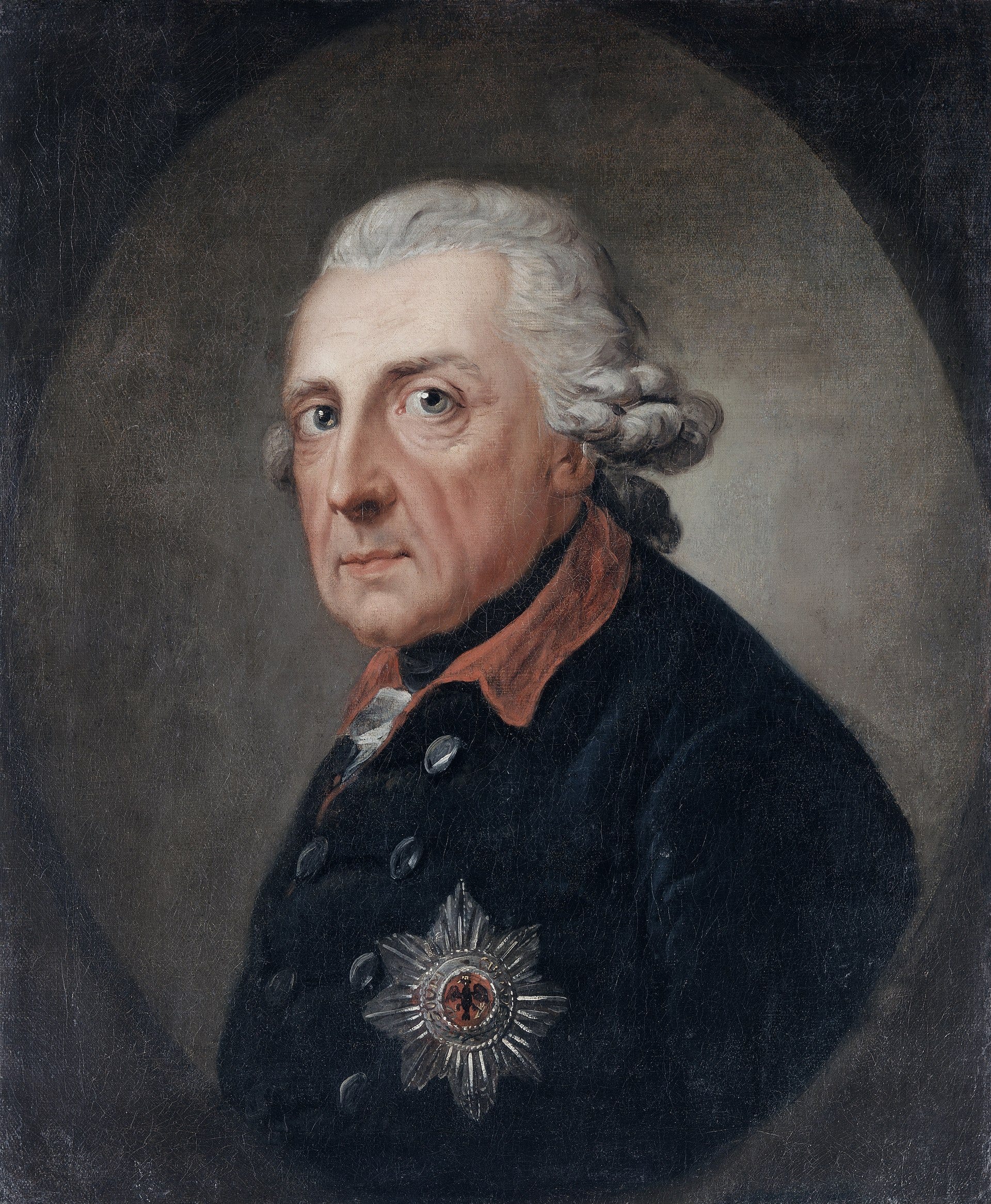
I’ve always suspected that it was Frederick who Adam Smith had in mind when he critiqued “the man of system” in the Theory of Moral Sentiments who is “wise in his own conceit” and imagines “that he can arrange the different members of a great society with as much ease as the hand arranges the different pieces upon a chess-board”.
Count Mirabeau saw Prussia as a classic example of how wasteful state direction of the economy could be:
“The King of Prussia recently gave six thousand écus for the establishment of a watch factory at Friedrichswalde. Such a small project was not worthy of this gift. It is easy to foresee that if this factory is not continually fed with further benefits, it will not sustain itself. Of all useless accoutrements, there is none more useless than a bad watch” (quoted in Clark, 2006, p. 179).
I’m not aware of cliometric research on this topic but from Clark and other sources it seems that some of Frederick’s investments paid off but most did not. Nor is there any accounting of the opportunity cost of these policies.
Nonetheless, as Noel Johnson and I emphasized in several papers (here, here, and here), despite its waste and inefficiencies mercantilism could pave the way for the expansion of markets because mercantilist policies often swept aside prior feudal laws and regulations which impeded the development of internal markets.
This fits Clark’s assessment of economic development in Prussia. He quotes the German historical school economist Gustav Schmoller as arguing that the mercantilist regime of Frederick the Great “had to fall in order that the seeds it had sown could bloom under the sun of industrial liberalism” (Clark, 2006, p. 179).
We are often told of the disagreements between the German historical school and the Austrian tradition in economics. It is therefore interesting that Schmoller’s position is also F.A. Hayek’s position in his The Constitution of Liberty. This is intriguing given that many classical liberals were initially wary of the concept of state capacity.
Here is what Hayek has to say about state development in Prussia:
“In view of the reputation which Prussia acquired in the nineteenth century, it may surprise the reader to learn that the beginning of the German movement for a government of law is to be found in that country. In some respects, however, the rule of enlightened despotism of the eighteenth century had been surprisingly modern there—indeed, one might say almost liberal, so far as legal and administrative principles were concerned. It was by no means a meaningless assertion when Frederick II described himself as the first servant of the state” (Hayek, 1960, p. 196).
Hayek specifically goes on to consider Frederick II’s legal code of 1751 which sought to both condense and simplify existing laws.
We saw in the previous episode that Frederick—despite his often arbitrary and autocratic behavior—acquired in popular legend a reputation of being constrained by law. Here is what Hayek has to say about developments in late 18th-century Prussia:
“The most distinctive contribution of eighteenth-century Prussia to the realization of the rule of law lay, however, in the field of the control of public administration. While in France the literal application of the ideal of the separation of powers had led to an exemption of administrative action from judicial control, the Prussian development proceeded in the opposite direction. The guiding ideal which profoundly affected the liberal movement of the nineteenth century was that all exercise of administrative power over the person or property of the citizen should be made subject to judicial review” (p. 198).
Overall, and due largely to the desire to build a stronger and more effective state apparatus, the Prussian state moved in the direction of ever more general statements of the rule of law.
Incidentally, a paper I just accepted for publication in Explorations in Economic History finds evidence consistent with this. The authors show that Frederick’s legal reforms increased the representation of women in the second-highest appellate court.
Identity Rules and General Rules
One way to think about the types of legal reforms made by Frederick II and his successors is through the lens of identity rules versus general rules. This is the framework that structures my book with Noel Johnson, Persecution and Toleration.
All societies rely on rules to govern behavior and ensure social order. But rules are expensive. They require enforcement and interpretation. As James C. Scott emphasized, most premodern states lacked the ability to comprehend the societies they sought to rule. Given this lack of legibility, attempts to construct fully general legal systems were always doomed to failure. The alternative most states fell back on was rule via identity rules.
Identity rules are a convenient shorthand for rulers who lack the capacity to treat individuals as individuals. Instead, they prescribe rules based on social status. So a serf is treated differently than a townsperson. A man is treated differently than a woman. These social identities reduce the costs of governance and they may well make sense given the level of technology available to governments before the industrial era. But they are incompatible with liberal notions of the rule of law.
The classic example of rule by identity rules we focus on in Persecution and Toleration is how different religious communities were treated in premodern states, e.g., dhimmi status in Islamic polities or the exclusionary treatment of Jews in medieval Europe. But this concept generalizes and is not specific to religious minorities.
The complex and overlapping legal system that characterized Prussia before the mid-18th century was a system of identity rules. Legal standards varied from one place to the next. Often the legal system was in the hands of local elites who could extract rents from it. The outcome was an often arbitrary system that treated similar cases differently and penalized non-elites.
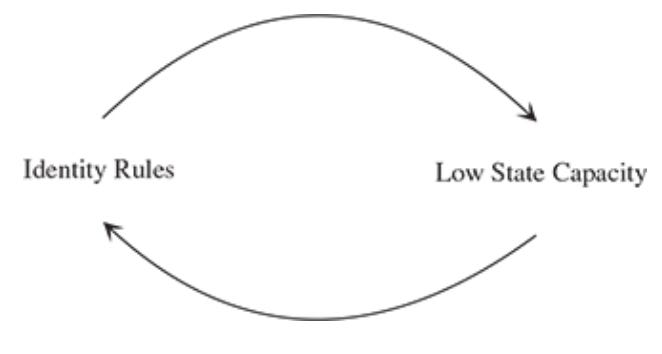
There is therefore a self-reinforcing relationship between reliance on identity rules and low state capacity as the above figure illustrates.
Nonetheless, developments over time made this equilibrium less stable.
Mercantilist and cameralist reformers came to realize that this system of overlapping jurisdictions and inconsistent legal results was bad for market integration, investment, and economic development. For quite practical and self-interested reasons, therefore, rulers like Frederick the Great in Prussia and Joseph II in the Habsburg empire had an incentive to streamline and rationalize it. This rationalization was itself a precondition for the development of markets and (this is the point that Billy Christmas really brings out) liberalism.
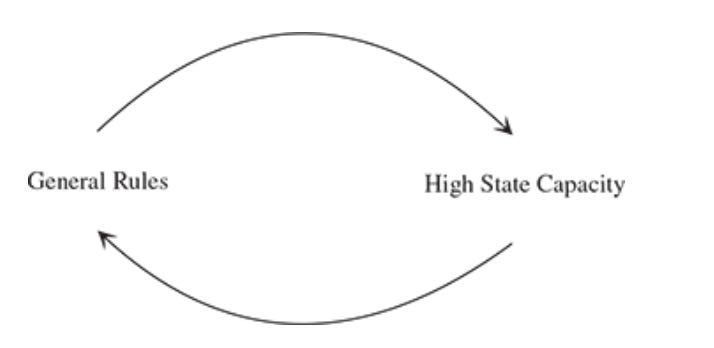
High state capacity makes possible market development because it is consistent with and supportive of governance by general rules as opposed to identity rules. Note that these are end-points and both state capacity and reliance on general rules can erode even in modern states (as they arguably have eroded in the modern West in recent decades).
Unleashing the Market
The third and final part of this essay will consider the consequences of the political and legal reforms made in the early 19th century following the twin shocks of the French Revolution and defeat by Napoleon.
To anticipate, traditional accounts of German industrialization contrast a period of relative stagnation before 1850 with rapid industrialization after 1850. They emphasize the innovations of the Second Industrial Revolution. Indeed, this is the version Jared Rubin and I provide in How the World Became Rich. We emphasize catch-up growth based on high levels of human capital and breakthroughs in areas such as chemical fertilizers. We didn’t have space in the book to go into the institutional preconditions of Germany’s rapid industrial and economic ascent. The next post will explore these.
Professor Koyoma,
You connect the pursuit of “a stronger and more effective state apparatus” with “ever more general statements of the rule of law.” You acknowledge Frederick II’s arbitrary conduct, but I would like to understand more precisely how the strengthening of royal administration translated into restraints on his intervention in judicial decisions. The Arnold affair of 1779–80 makes that question concrete.
Christian Arnold, the hereditary tenant of a watermill in the Neumark, fell behind on his rent. He attributed his difficulties to a neighboring landowner’s fishpond, which he alleged deprived his mill of water. His landlord obtained a judgment for the arrears, and the mill was subsequentrly sold at auction. After repeated adverse rulings, Arnold successfully sought redress from Frederick II.
Frederick dispatched Colonel von Heucking to investigate. Heucking’s report supported the millers’ complaint, but the Kammergericht—the royal high court in Berlin—upheld the earlier decisions against them. Frederick rejected that conclusion, dismissed Grand Chancellor von Fürst, and had judicial officials arrested. Writing to his justice minister, Zedlitz, he declared:
“I give more belief to an honest Officer, who has honor in the heart of him, than to all your Advocates and sentences.” < https://www.digitale-sammlungen.de/en/view/bsb11236309?page=527,528>
When Zedlitz refused to pronounce the condemnation Frederick demanded, the king imposed the sentence himself. What more, he imposed punishments on judges, On 1 January 1780, he ordered six judicial officials dismissed, sentenced to a year’s fortress imprisonment, and required to compensate the Arnolds from their own resources. < https://www.digitale-sammlungen.de/en/view/bsb11236309?page=529,530> To the best of my knowledge, they were subsequently confined at Spandau and released in September, before completing their full term.
I must therefore ask: Does Frederick’s preference for an officer’s honor over judicial reasoning (what one might even call "the rule of law") therefore not suggest that social identity continued to shape whose judgment he trusted? It suggests that actual history is much more messy than your images of “Identity Rules” and “General Rules” above suggest, to the point of being unrecognizable. To me, the Arnold affair demonstrated that, for good and for ill, Frederick II was more than willing to take the law into his own hands when he believed conventional rules were unjust.