

Advances in AI mean that academic journals are already getting bombarded by fake papers. We all know this. But there are fake papers, and there are fake papers. And a recent submission to Explorations in Economic History definitely falls into the latter category and I thought it was worthwhile sharing.
This paper is called “Did Textile Industrialization Amplify Electoral Support for the Radical Left? Evidence from the 1918 Ottoman Constitutional Elections” and on the surface it looks like a plausible paper. There is a valid research question and an identification strategy, so I was about to send it out to trusted Ottoman experts to referee . . .

But before I did so something didn’t sit right with me . . . were there elections in the Ottoman empire in 1918? And was there an Ottoman Constitutional Assembly?
The answer to both questions it turns out is . . . no and no.
Below I outline quite how outlandish and incompetent a forgery this turned out to be.
Distance to Petrograd?!
At this point, I had Claude take a look at the paper. Did the authors simply get the date wrong for the Ottoman elections or was it deeper than that? There were elections in 1919 for example. Claude, however, immediately flagged that every regression controlled for “Distance to Petrograd” and “Distance to Moscow” as well as “% Slavic speakers”. Then it twigged. There were elections to the “Constitutional Assembly” in Russia in late 1917 and in fact everything in the paper is actually about Russia and not the Ottoman empire. The entire historical setting is fictitious.
In summary, what I learned from Claude was that everything about the paper was fake. No elections in 1918. The parties it describes such as the Socialist-Federalist coalition and the Social-Democratic Party did not exist. The election system of proportional representation was never used in any Ottoman election. It refers to parts of the Ottoman empire participating in the election of 1918 that had been lost to Greece years earlier. The final give away is apparently according to the author “the emancipation of serfs . . . began the main growth phase of industrialization”.
So it wasn’t just an AI-written paper, though the writing itself shows all the signs of AI. It was a bizarre attempt to transpose analysis of the Russian Revolution to the Ottoman empire.
The Ripped-Off Paper
Again Claude was very helpful in assisting me in finding the paper that the author stole from. This was Castañeda Dower and Markevich, “Did Industrialization increase support for the radical left? Evidence from the 1917 Russian revolution” published in the Journal of Comparative Economics in 2025.
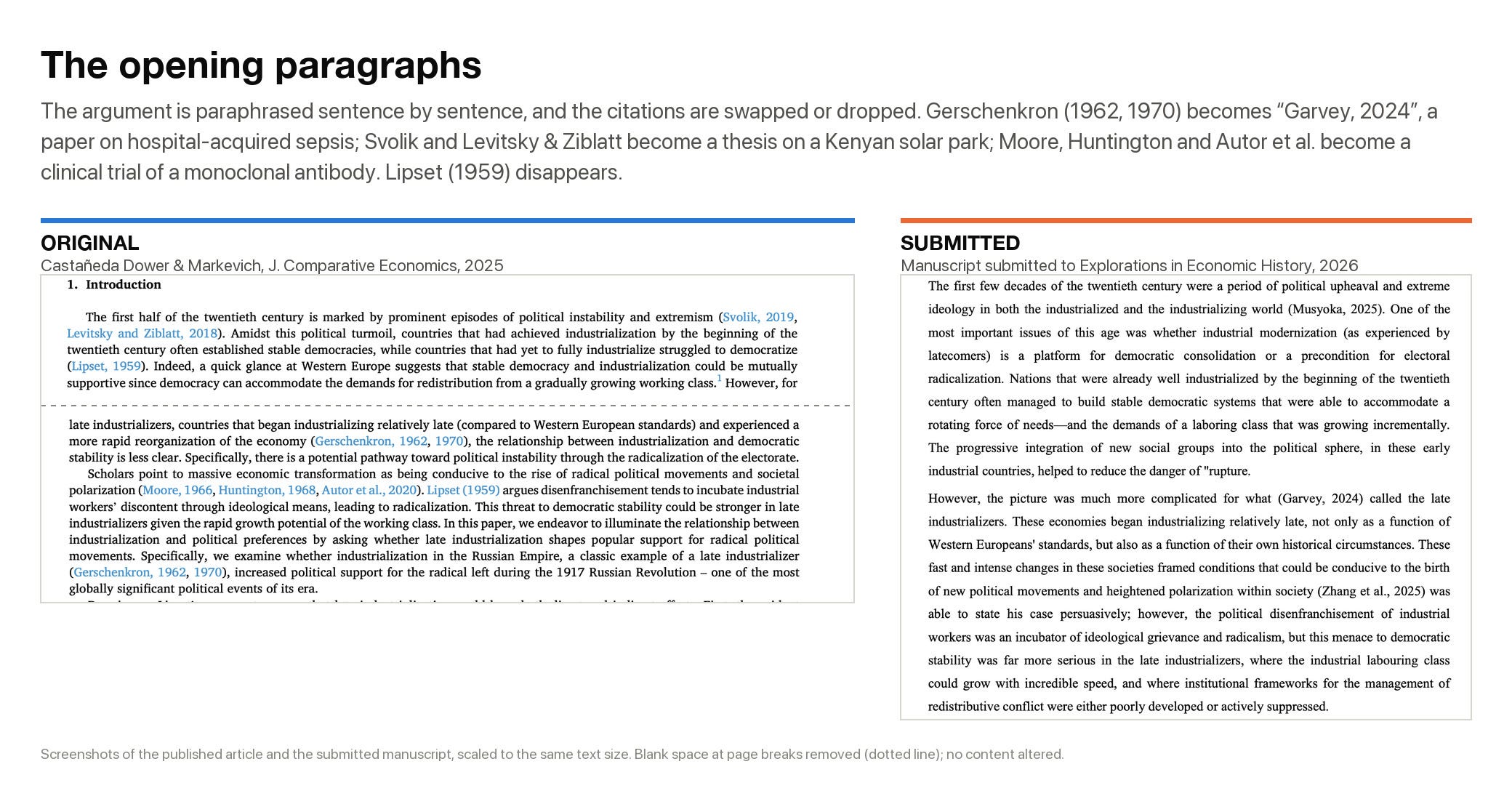
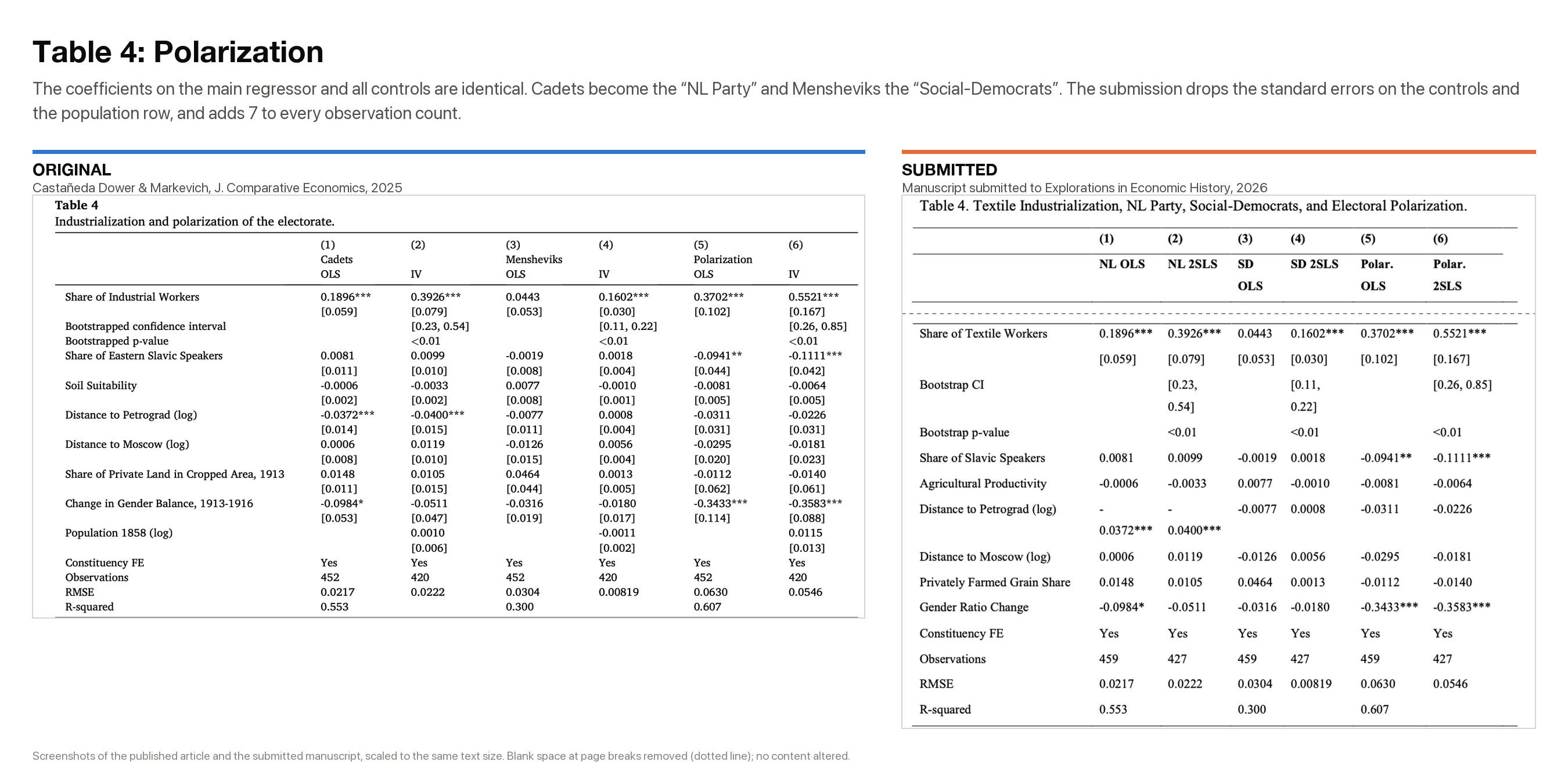
This is an excellent paper that I fully recommend you read. The paper that was submitted to Explorations turns out to be a mangled version of a recent and rigorous analysis of the Russian Revolution. The text is different and so the fake paper might well survive a naive plagiarism test but it is clearly derivative as this side-by-side comparison illustrates:
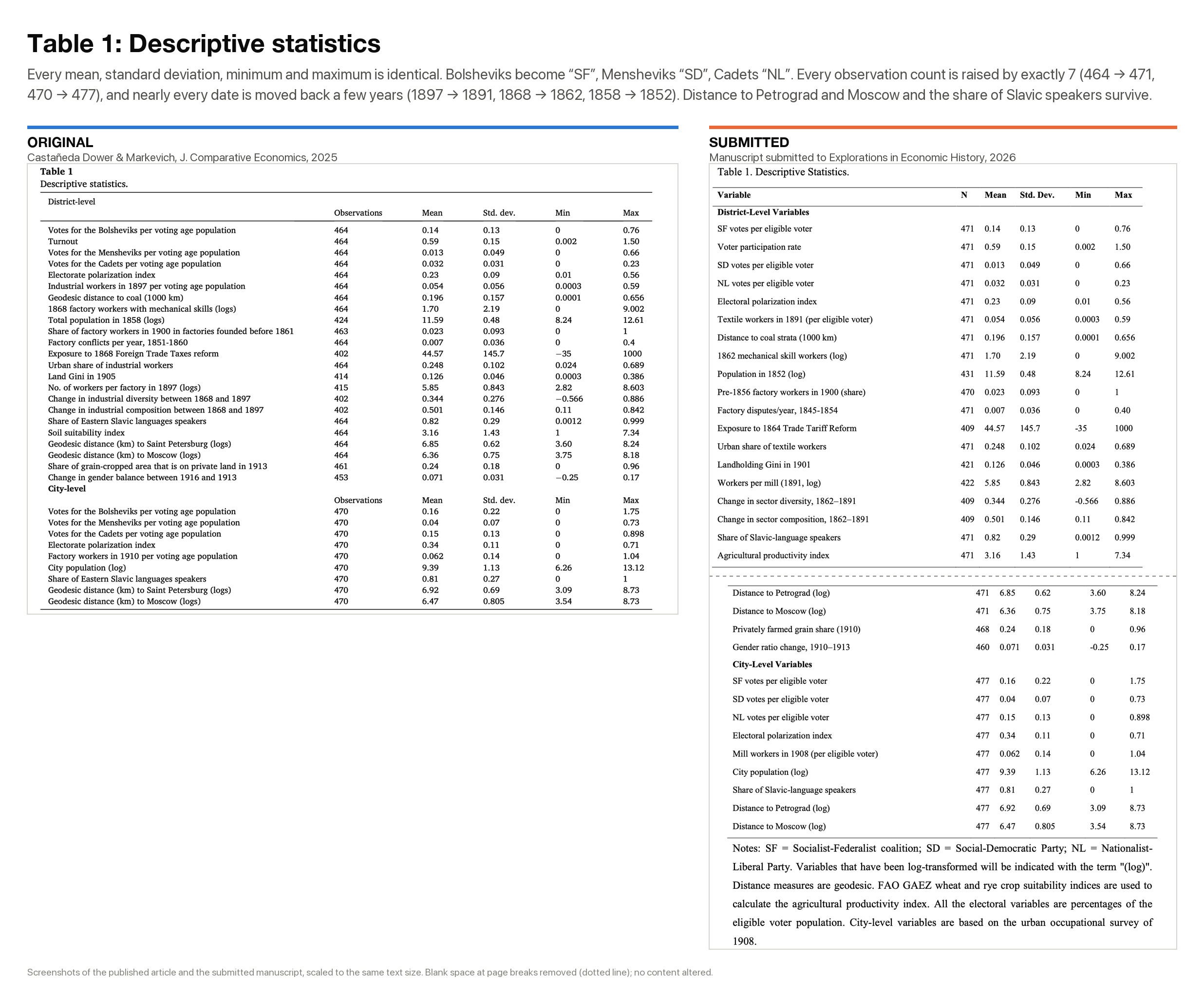
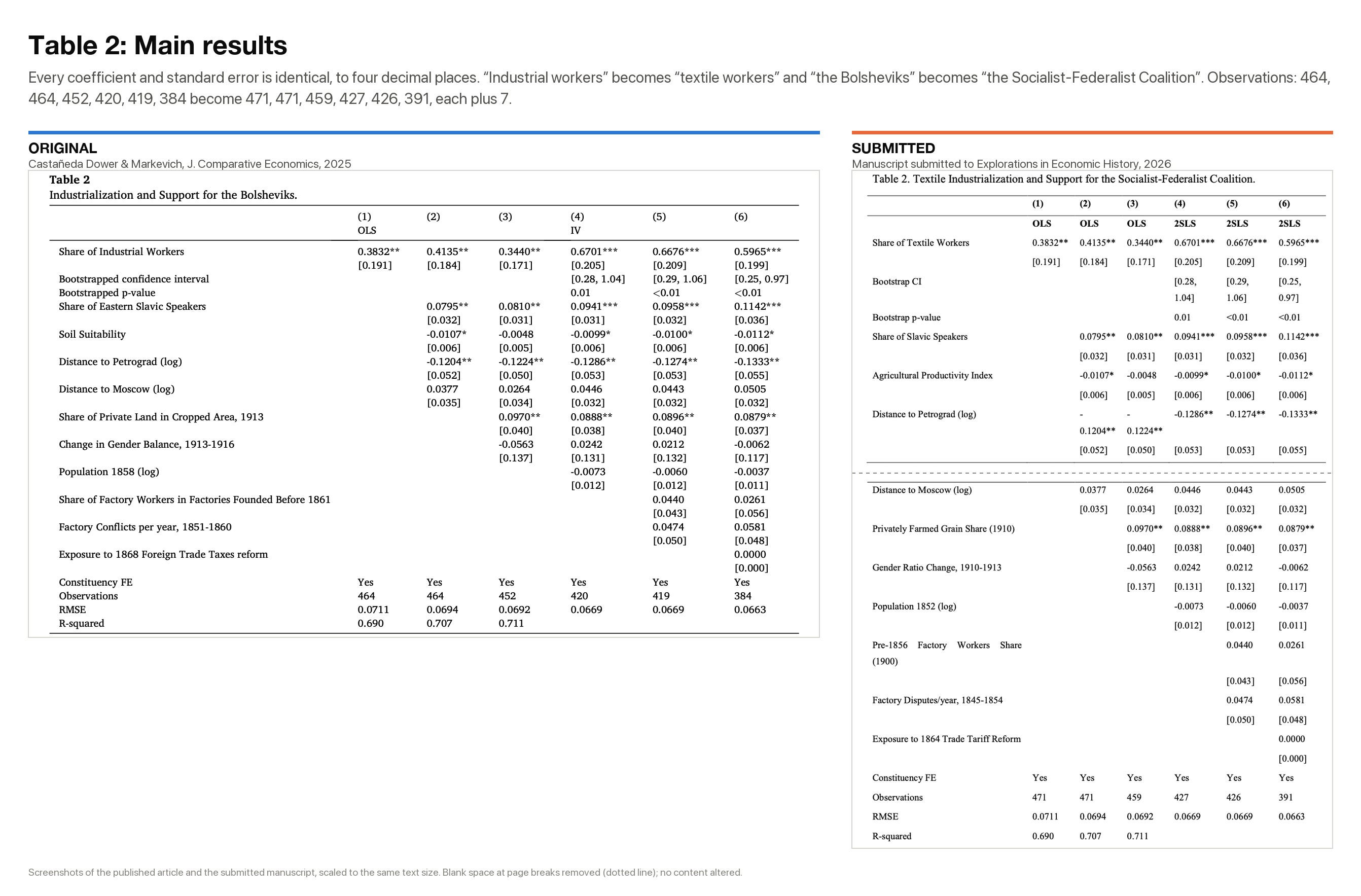
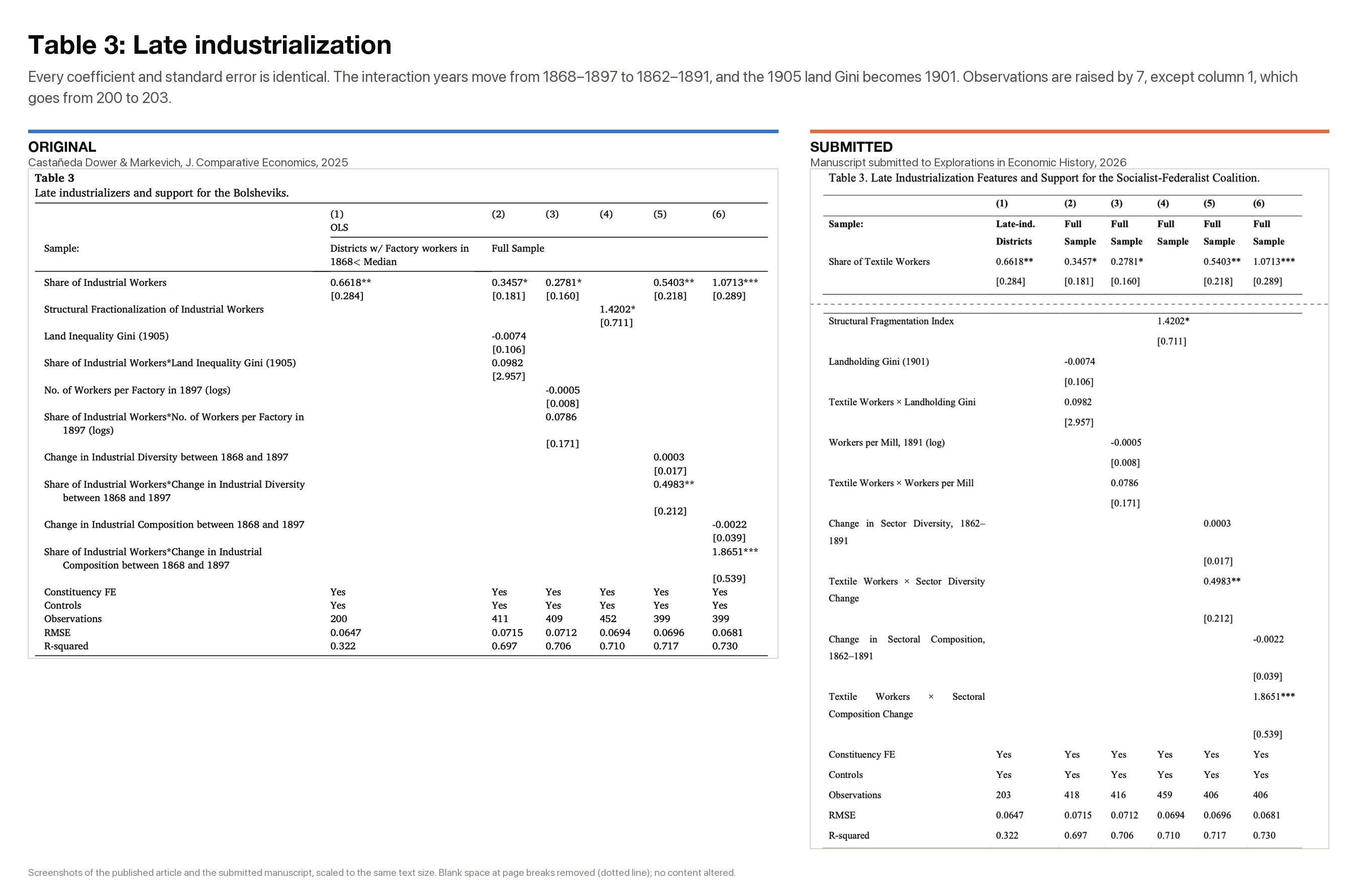
But what is still more striking is that all of the empirical analysis in this paper is copied word for word from the JCE paper on the Russian Revolution. This is why they have variables such as Distance to Petrograd in their descriptive statistics. The author of the fake paper didn’t even bother to generate new numbers.
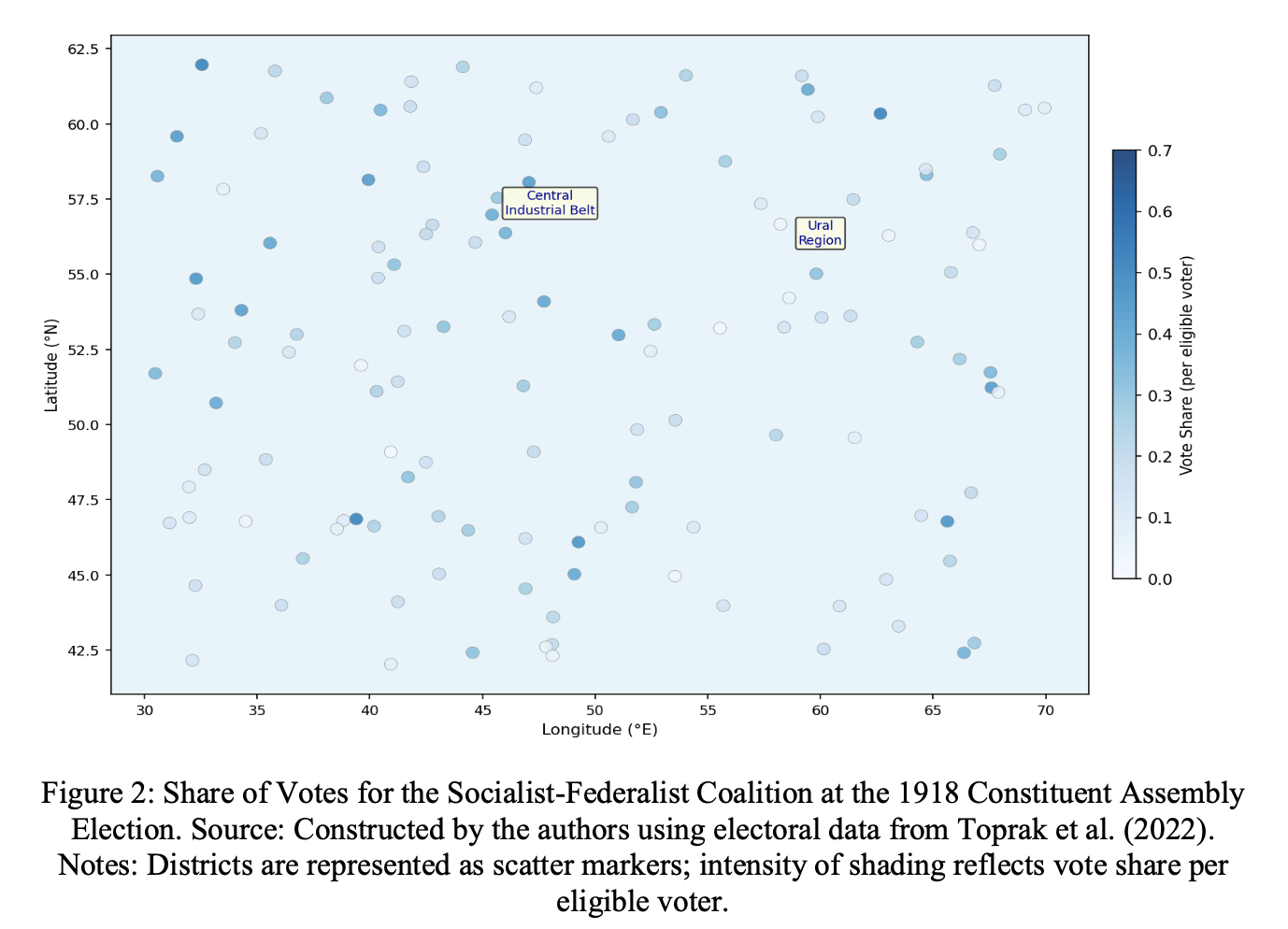
The really weird one is that the author of the fake paper generated a bizarre map with geo-coordinates.
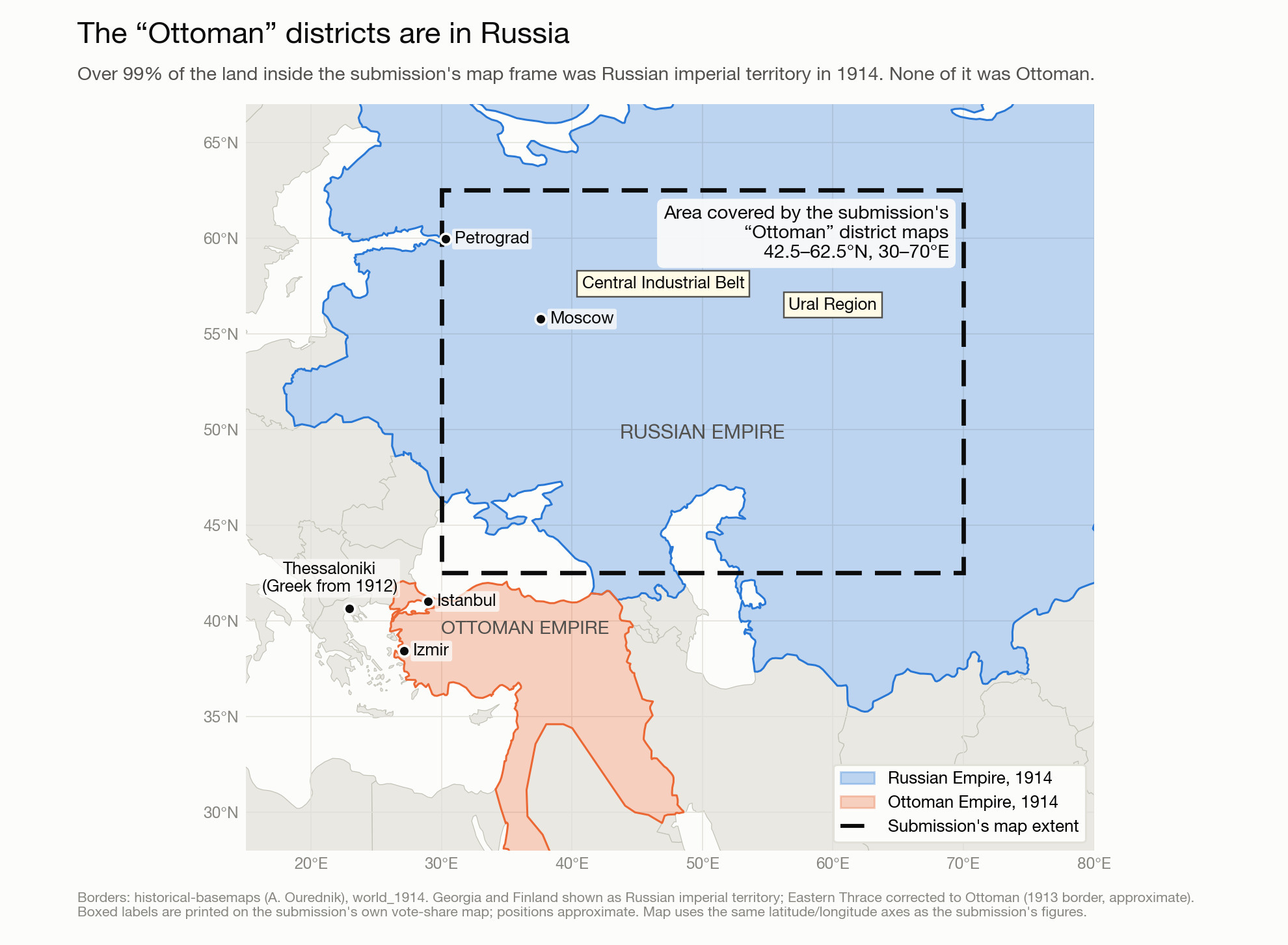
Of course, latitude 62.5 degrees is really far north, far further north than modern-day Turkey. So what do the map’s geo-coordinates correspond to?
The References!
Finally we get to the references. It is well known that AI can hallucinate references. And my first assumption was that this is what this author had done. That Garvey (2024) was going to be plausible-sounding but non-existent paper on the Ottoman empire.
But that would be too logical! There are two relevant citations in the paper: Lipset (1959) on the famous modernization hypothesis and Davidson and MacKinnon (2010) on wild bootstraps for standard errors. But almost all of the papers cited are real recent papers on random topics.
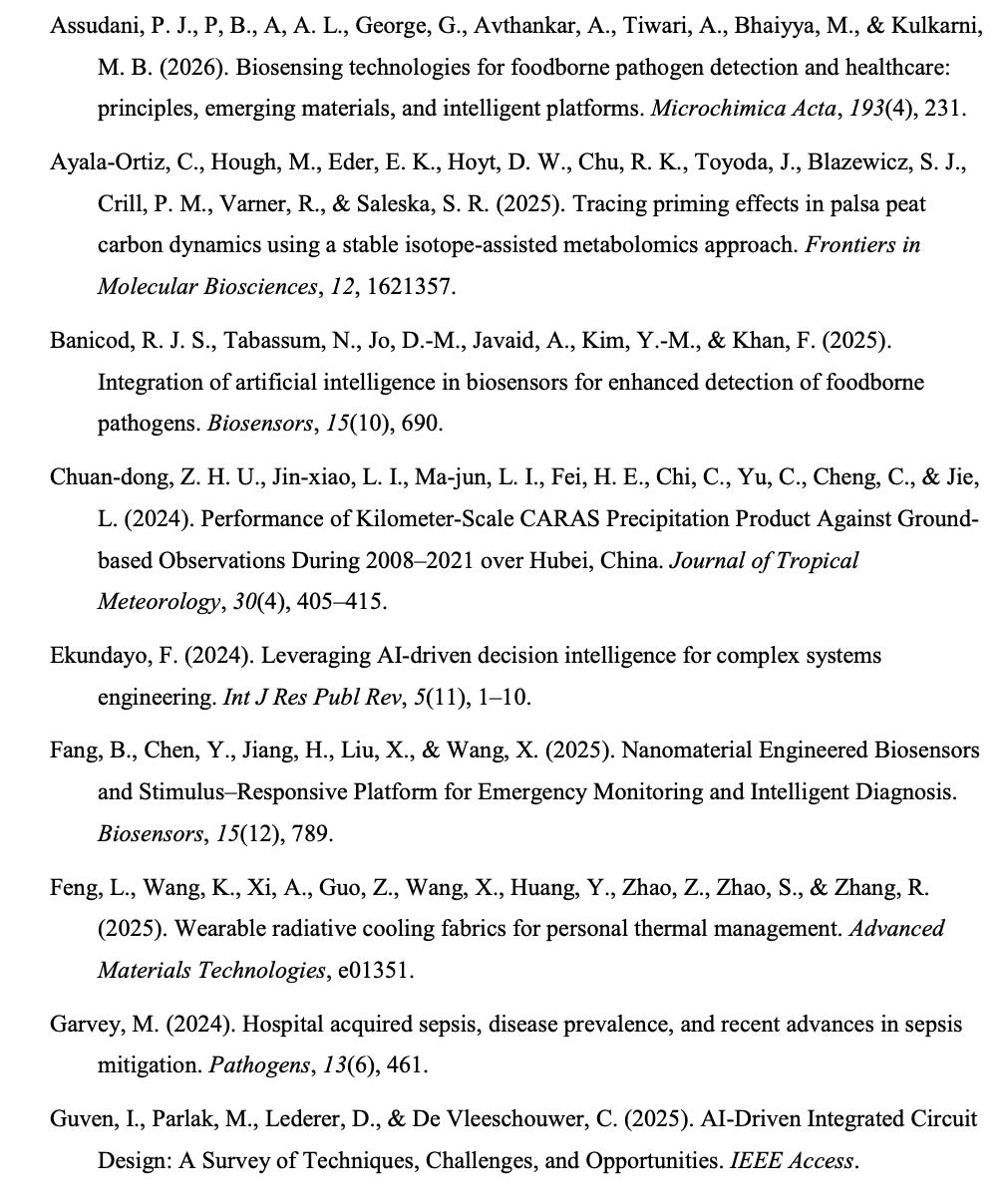
Why do this? I asked Claude and it suggested that the author might be selling citations. That is, the fake author could be earning money by citing real papers in his fake paper thereby inflating citations counts. However, when I asked it to investigate further it found no evidence of this. No evidence that these papers belonged to a fixed bundle of references being cited in random papers. Nor are these papers cited off-topic elsewhere. So it seems more likely that they come from an automated “find me a citation” tool with no relevance check, or from a reference list lifted from some other document.
What This Means for Academic Publishing
So what, a fake paper got submitted. Why did I waste so much time analyzing it? The real issue is what this means for journals and academic publishers. Elsevier provide tools for identifying multiple submissions and old-school plagiarism. But there is no strategy for dealing with fake AI papers, the vast majority of which will be much more sophisticated than this one.
The impact on academic journals is potentially devastating. I almost sent this paper out for referee. Had I done so I would have wasted the valuable time of scholars who review papers for free on the basis of trust. We are already facing a crisis of refereeing outside the top journals. Explorations continues to do relatively well because of the good will and high social capital of the members of the economic history community. But I wonder how long this can survive.
And who was the supposed scholar who submitted this paper?
What a shame! It would help if universities took research misconduct more seriously, but I don't think administrators have enough incentive to care without some external pressure like bad press.