

To honor the Bayeux Tapestry coming to English shores, here is a post on a pressing geopolitical question: how wealthy was Anglo-Saxon England?

The backstory is that I was listening to the Rest is History’s great series on 1066. There Tom Holland made the striking claim that England was perhaps the wealthiest country in Western Europe at the time. He was clear that Anglo-Saxon England wasn’t necessarily wealthy in any absolute sense of the word but at the same time, it was noticeably more prosperous than its neighbors and it was this that made it a target for external predators like the Vikings and Normans.
And Holland is not alone in thinking this. Peter Sawyer in his published lectures, The Wealth of Anglo-Saxon England, makes the claim that
“on the eve of the Norman Conquest, England had become an exceptionally wealthy, highly urbanized kingdom, with a large, well-controlled coinage of high quality” (Sawyer, 2013, p. 1)
Indeed, these views are pretty much the consensus assessment of medievalists who study this period.
What is curious is that they are almost completely at odds with what economic historians would say about 11th-century England.
For example, many books on the Great Divergence begin by making the point about how backward Western Europe, and specifically the British Isles, was c. 1000 AD.
The Malthusian Perspective
A benchmark economic historians have at their disposal for thinking about this type of question is the Malthusian model. The idea is that the long-run population of an area gives you a good idea of agricultural productivity (because in the long run, excess food is converted into more people).
If this is a good indication of how productive Anglo-Saxon England was then it does not suggest an unusually productive economy. Domesday Book records around 270,000 heads of household, and turning that into a population total requires a multiplier for household size plus an allowance for the people and places Domesday leaves out. Josiah Cox Russell’s multiplier of 3.5 gives a population of about 1.1 million. But this is likely too low. F.W. Maitland’s multiplier of 5 gives about 1.5 million and the most widely used figure among economic historians today is Broadberry et al.’s (2015) estimate of about 1.7 million for 1086. Some historians have argued for higher totals, above 2 million, and there is genuine uncertainty here (Hallam, 1988).
But even on the high estimates, this population was low compared to the medieval peak c. 1300, when Bruce Campbell puts it at between 4 and 6 million (Broadberry et al., 2015 settle on about 4.75 million).
Importantly, estimates for English population numbers c. 1066 are within the estimates given by historians for the population of Roman Britain. Some historians have suggested Roman Britain may have numbered as many as 4 million people, although this is likely an optimistic upper bound.
Of course, populations can collapse for many reasons. England’s late medieval population was low due to the impact of bubonic plague. But if we accept the basic premises of the Malthusian framework, it seems like Anglo-Saxon England’s carrying capacity or the productivity of its agrarian economy was not unusually high. It supported roughly as many or fewer people than it had roughly a thousand years earlier.
What About Urbanization?
There are limits to the insights we get from the Malthusian model, of course. One limitation of it is that it is based on the idea that all workers are employed in agriculture and it doesn’t take into account the productive role of cities (where, over some range, increasing returns may obtain). Renaissance Italian city states were remarkably prosperous and one of the reasons we know this is that they supported very high rates of urbanization. Similarly, high levels of urbanization are one of the strongest pieces of evidence we have for thinking that the Roman and Greek economies at their height were highly productive.
In contrast, however, Anglo-Saxon England had few large towns or cities. On the eve of the Conquest, London and York were the largest towns. Estimates for London range from around 10,000 to 25,000, and York had perhaps 10,000. Norwich and Lincoln had perhaps 6,000. Everywhere else was much smaller. Richard Britnell estimates that around 10 percent of the population lived in towns by 1086, and the share was probably lower c. 1000 (Britnell, 1993; Dyer, 2002). By 1300, it had risen to perhaps 15 percent or more.
These numbers look small by comparison with the great cities of the 11th-century world. Paul Bairoch (1988) famously put the population of Umayyad Córdoba at around 450,000. Later work has revised this down considerably. Bosker, Buringh and van Zanden (2013), following Glick (1979), put Córdoba at about 100,000 in 1000. But Córdoba was still huge compared to any English town. The same dataset puts London at about 25,000 in 1000, which is a generous figure, and York at about 12,000. On these numbers Córdoba was four times the size of London. Constantinople and Baghdad had around 300,000 inhabitants each, and Cairo (Fustat) around 135,000 (Bosker et al., 2013; again, these are conservative estimates, I’ve seen people go up to 400,000 for Constantinople in this period). Kaifeng, the Northern Song capital, may have approached a million. Nothing like this scale of urbanization and hence commerce, trade and economic specialization can be observed in the British Isles until the 17th century.
What about GDP per capita?
Broadberry, Guan and Li (2018) put together some comparative estimates of historical GDP per capita. Their main focus is China but they include estimates for 11th-century England as a comparator. Of course many caveats apply here but the numbers are roughly in line with what we might expect and don’t support claims that Anglo-Saxon England was especially or uniquely prosperous.
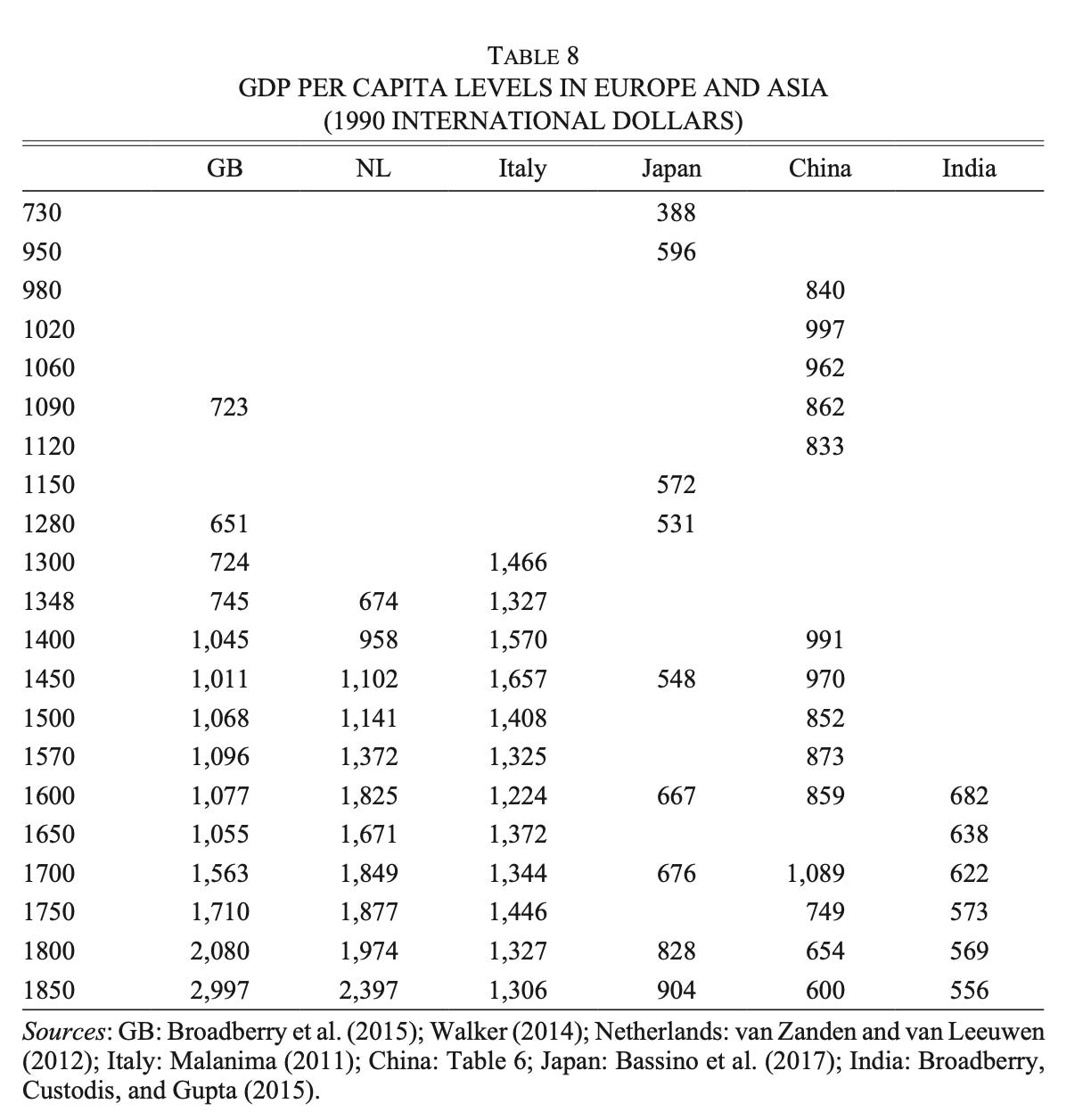
The figure of 723 (1990) dollars is significantly above subsistence (roughly 400 (1990) dollars). So Broadberry et al. think there is something to claims of Anglo-Saxon prosperity. But it is also significantly below the estimates given for Song China or for Italy in the Renaissance. It was roughly the same as the per capita income they estimate for England in 1300 when the population of England was roughly double what it had been in 1090.
The narrow claim that Anglo-Saxon England was likely richer than its peers (endemic war was more common in post-Carolingian Francia) might well be correct. There are no reliable output estimates for northern France, Flanders or Germany at this date, so it is quite possible and indeed likely that English per capita income was higher than theirs.
That is essentially what historians like Holland and Sawyer are claiming. But to my mind the relevant comparison for “exceptionally wealthy” should be with the richest economies of the period. On that comparison, England looks like it was clearly behind al-Andalus, the Byzantine Empire, the Islamic Middle East and Song China. And the evidence on real wages suggests that Iraq and Egypt enjoyed a period of high living standards between the 8th and 11th centuries (Pamuk and Shatzmiller, 2014).
What about the massive amounts of Dangeld?
So where do the claims for the wealth of Anglo-Saxon England come from? The main reason seems to be its coinage and the ability of the Anglo-Saxon state to pay huge amounts of Danegeld to basically buy off Viking invaders. These amounts, such as the 36,000 pounds Ethelred the Unready paid in 1007, dwarf the amounts of tax revenues that later medieval kings could bring in and they suggest an immensely wealthy king (especially as the Vikings kept coming back, these amounts kept going up).
John Gillingham raised skepticism about the numbers recorded in the Anglo-Saxon Chronicle back in 1989 and I am in general quite persuaded by his arguments. My understanding, however, is that the consensus view of Anglo-Saxon historians is that the numbers are reliable and that the Anglo-Saxon state was indeed able to raise vast sums of coinage and precious metals as Danegeld.
But if these numbers are roughly accurate, what do they imply about the prosperity of Anglo-Saxon England?
It is worth being clear about how large they are. The Chronicle records 72,000 pounds raised in 1018, plus a further 10,500 from London. As Gillingham points out the geld of 1130 brought in less than 2,500 pounds. No English tax appears to have raised as much as the 1018 levy until the reign of Edward I, after more than two centuries of population and economic growth (Gillingham, 1989).
If we take these numbers seriously, there are two ways to interpret them. The first is the one favored by Anglo-Saxon historians. Late Anglo-Saxon England had a highly capable state and a highly monetized economy, and so the king could tax a broad base of taxpayers in coin.
But there is a second way of thinking about this that I believe has not been discussed in the literature.
This is that, if most of the surplus was held by a small elite, a state only needed to squeeze a relatively small number of great landholders to raise very large sums. On this reading, England’s ability to pay off the Vikings tells us about the distribution of wealth rather than about how rich the country was.
Again, the Malthusian model helps clarify why these are different claims. In the simple Malthusian model taxes, rents and expropriations do not affect per capita income in the long run. They reduce population. Income per head is pinned down by the birth and death rates, so if the elite or the state takes a larger share of output, there are simply fewer peasants living at the same standard of living. A heavily taxed Malthusian economy is not a poor one per head. It is a smaller one.
I would love to be wrong here, but my impression is that inequality has not been built into these models in a very systematic way. But in one of my favorite papers, Branko Milanovic, Peter Lindert and Jeffrey Williamson (RIP) (2011) offer a useful way of thinking about it. In a pre-industrial society, the maximum amount of inequality is limited by how far average income sits above subsistence, because the masses cannot be pushed below subsistence for long. They call the share of this maximum that elites actually take the “extraction ratio”, and they find that many pre-industrial societies came close to the maximum. If English GDP per capita was around 723 dollars and absolute subsistence around 400 dollars, then something like 45 percent of output was, in principle, available to be extracted. That is plenty to pay Vikings with, if it was in the hands of a small number of people and the state could extract it.
The reason I think this is plausible is that we do know that landed wealth in late Anglo-Saxon England was highly concentrated. Domesday Book provides estimates that allow historians to reconstruct landholding in 1066 as well as in 1086. It shows that a small group of earls and great thegns held a very large share of the land. Robin Fleming (1983) shows that on the eve of the Conquest the Godwine family’s estates were worth more than the king’s. There was a small group of great lay magnates who held much of the kingdom’s landed wealth. And then we also know there were a lot of very poor and dispossessed people, as around 10 percent of the population recorded in Domesday Book were slaves. Lawson (1984) shows that under Cnut, landholders who could not pay the geld forfeited their estates to whoever would pay it for them. This is a mechanism for extracting surplus from landholders.
But what about the coinage?

This is the Lenborough Hoard, discovered in 2014 and the height of the “Dangeld-era”. In today’s money it might be worth as much as 1.3 million pounds.
Again the quality and amount of late Anglo-Saxon coins is typically cited as a measure of “wealth”. But in fact coinage doesn’t have to correspond to wealth. We now believe that sustained economic growth began in 17th century England. But the coinage of this period was famously terrible.
Anglo-Saxon England was highly monetized in the sense that there was a lot of coin. But my hunch is that low levels of urbanization suggest that this monetization was not the result of extensive commerce and trade. A kingdom in which perhaps one person in ten lived in towns, and the largest town had perhaps 10,000 to 25,000 people, is not my idea of a highly commercialized economy. It looks like a rural economy with a very effective fiscal state. Much of the demand for coin may have come from the state itself, through taxation, frequent recoinages and the aforementioned Danegeld.
Putting this together, I think the most plausible reading of the evidence is this. Anglo-Saxon England had a remarkably capable state. Its wealth was highly concentrated and highly visible: in the estates of a small elite, in church treasuries, and in a closely managed silver coinage. That made it a very attractive target for Vikings and Normans. But, and this is the important point, none of this is the same as being a wealthy economy. In Malthusian terms, the vast sums paid as Danegeld were a drain of surplus that would have shown up in population, not in living standards. And the population of England in the 11th century was, as we have seen, not especially large.
References
Bairoch, P. (1988). Cities and Economic Development: From the Dawn of History to the Present. Chicago: University of Chicago Press.
Bosker, M., Buringh, E. and van Zanden, J.L. (2013). “From Baghdad to London: Unraveling Urban Development in Europe, the Middle East, and North Africa, 800–1800.” Review of Economics and Statistics 95(4): 1418–1437.
Britnell, R.H. (1993). The Commercialisation of English Society, 1000–1500. Cambridge: Cambridge University Press.
Broadberry, S., Campbell, B.M.S., Klein, A., Overton, M. and van Leeuwen, B. (2015). British Economic Growth, 1270–1870. Cambridge: Cambridge University Press.
Broadberry, S., Guan, H. and Li, D.D. (2018). “China, Europe, and the Great Divergence: A Study in Historical National Accounting, 980–1850.” Journal of Economic History 78(4): 955–1000.
Darby, H.C. (1977). Domesday England. Cambridge: Cambridge University Press.
Dyer, C. (2002). Making a Living in the Middle Ages: The People of Britain 850–1520. New Haven: Yale University Press.
Fleming, R. (1983). “Domesday Estates of the King and the Godwines: A Study in Late Saxon Politics.” Speculum 58(4): 987–1007.
Gillingham, J. (1989). “’The Most Precious Jewel in the English Crown’: Levels of Danegeld and Heregeld in the Early Eleventh Century.” English Historical Review 104(411): 373–384.
Glick, T.F. (1979). Islamic and Christian Spain in the Early Middle Ages. Princeton: Princeton University Press.
Hallam, H.E. (ed.) (1988). The Agrarian History of England and Wales, Vol. II: 1042–1350. Cambridge: Cambridge University Press.
Lawson, M.K. (1984). “The Collection of Danegeld and Heregeld in the Reigns of Aethelred II and Cnut.” English Historical Review 99(393): 721–738.
Milanovic, B., Lindert, P.H. and Williamson, J.G. (2011). “Pre-Industrial Inequality.” Economic Journal 121(551): 255–272.
Pamuk, Ş. and Shatzmiller, M. (2014). “Plagues, Wages, and Economic Change in the Islamic Middle East, 700–1500.” Journal of Economic History 74(1): 196–229.
Sawyer, P. (2013). The Wealth of Anglo-Saxon England. Oxford: Oxford University Press.
I agree.
I am very skeptical of the claim that Anglo-Saxon England was significantly wealthier per capita than other Eurasian societies. I think that it took centuries for England to achieve that level.