

Castles and medieval Europe are inseparable in our historical imagination. My own interest in history was cemented by visiting the magnificent castles that Edward I built in North Wales.
But we often forget one crucial feature of medieval castles: many of them did not belong to the king but rather were the “private” possessions of feudal barons.
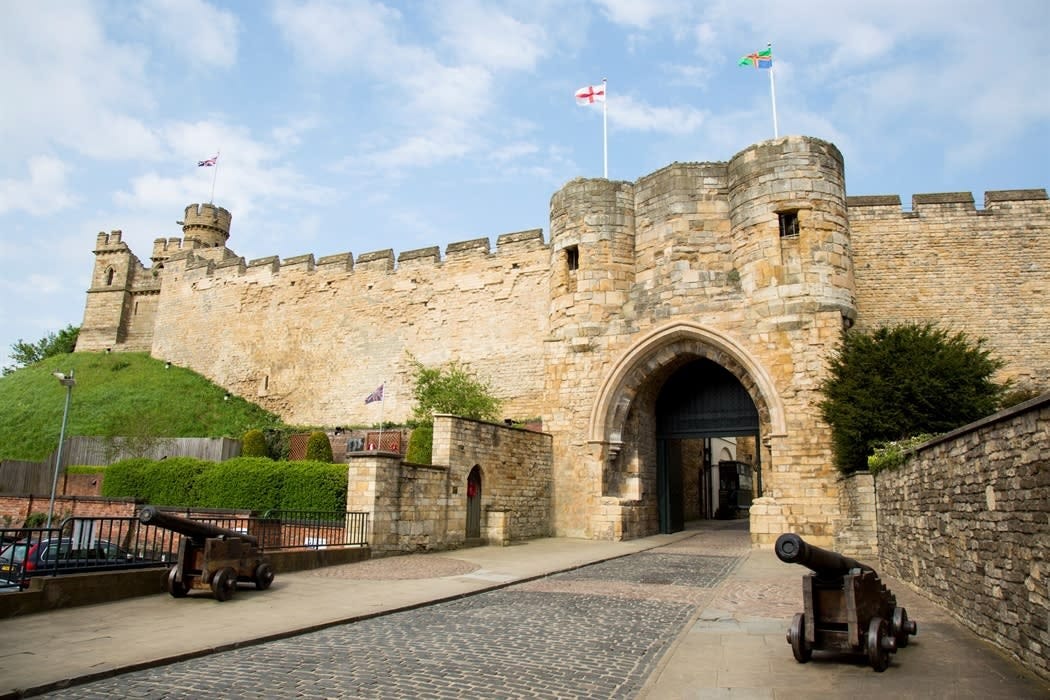
We are tempted to take the persistence of private military fortifications throughout the Middle Ages for granted. But this is in fact a puzzle.
One that Desiree Desierto and I explore in a recent paper published in European Economic Review.1
The Barbarian Invasions and the Emergence of Defense-in-Depth
Two preconditions were important in the proliferation of private castles across medieval Europe: (i) external invasions and raids; and (ii) the collapse of public authority over much of Western Europe.
The logic of defense-in-depth is laid out in Edward Luttwak’s classic The Grand Strategy of the Roman Empire. At the height of the principate, the Roman empire invested in a system of linear defenses. Static defense was expensive but if it held, it could provide peace and stability for the interior. But with more mobile invaders, a static perimeter defense had to be abandoned in favor of defense-in-depth. This is what happened in the later Roman empire, as linear defenses were abandoned for self-contained strongholds.
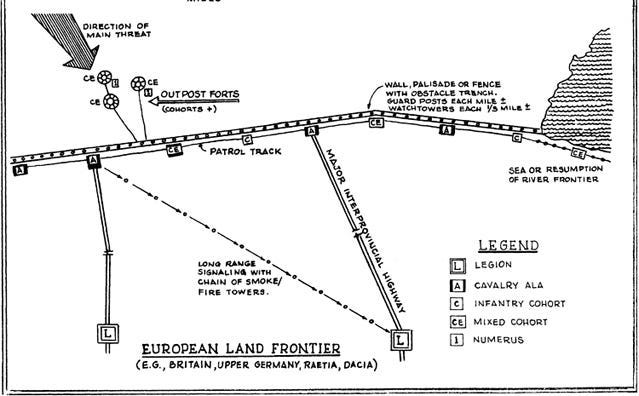
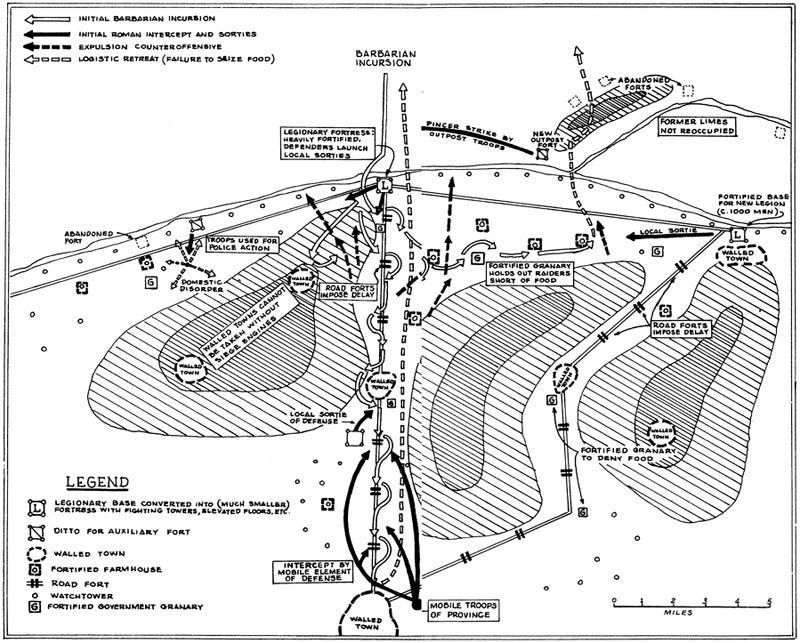
Luttwak’s concerns were the barbarian invasions of the 3rd and 4th century. But the logic also applies to the invasions that beset Western Europe between the 8th and 10th centuries.
Raids from Scandinavia intensified after around 800 CE. These were made possible by innovations in longship design which meant that raiders from Scandinavia posed a threat to the rulers of sedentary populations across Europe. Their ability to choose where and when to attack, to navigate river-ways and penetrate deep inland rendered static defenses ineffective.
In addition to Viking raids, there were intensified attacks from the Eurasian Steppe. Nomads like the Magyars possessed comparable mobility across land and conducted lightning raids hundreds of miles from their base in the Hungarian plain.
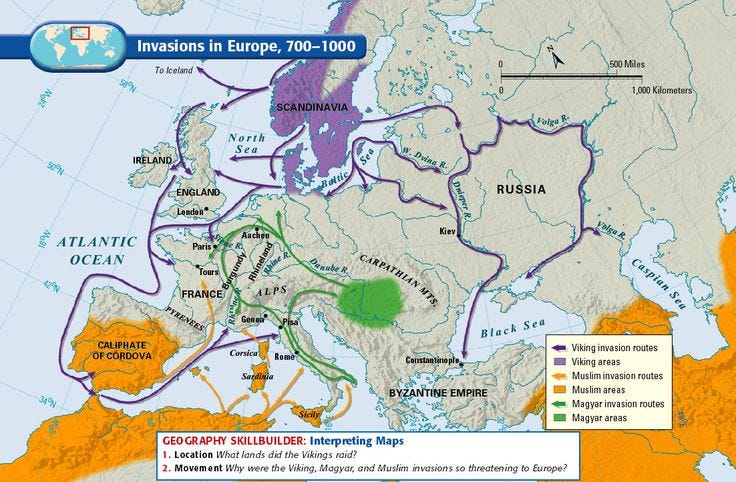
Defense-in-depth required self-contained fortifications that could hold up invaders, prevent them from raiding the nearby countryside, and provide time for a reinforced defense force to be assembled. While the threat of external invasion explains the need for fortifications and defense in-depth, it does not account for why so many of the fortifications of the Middle Ages were private fortifications. After all, the fortifications of the late Roman empire were built and controlled by a centralized state.
This brings us to the second precondition: the collapse of centralized political authority.
The fall of the Western Roman empire in the 5th century had been accompanied by the decentralization of political and military authority. During the 8th century, the Franks under the Carolingian dynasty restored a measure of public authority. But their empire lacked strong fiscal or administrative foundations and in response to the raids of invaders and internal conflict, real power devolved from the royal court to a new provincial aristocracy.
As military and judicial power localized, the power of the king was hollowed out. This process reached its culmination in 11th century Francia, or France, where the early kings of the Capetian dynasty became equivalent in power to many of the territorial lords. This period of weakening central authority is associated with the rise of feudalism.
Was the proliferation of the baronial castles in the 11th and 12th centuries evidence of state weakness or was it part of a distinctive feudal political order?
Baronial Castles as a Measure of State Weakness
From the perspective of modern social science it is natural to view the proliferation of private castles as a measure of state weakness. In a fantastic paper that I hope is published soon, Cappelen and Hariri introduce a dataset of medieval castles. They put this important data to work by using castles
“ . . . to trace the gradual monopolization of the means of violence in medieval and early modern Europe. Because castles are physical structures with coercive potential, castle ownership measures the extent to which the means of violence have been monopolized by the Crown.”
For Cappelen and Hariri as political scientists, the share of castles that were controlled by the ruler versus the proportion controlled by the barons is a natural measure of state development. As they write, this ratio “can be used to trace historically the rise of the attribute that is distinctive of the modern state: that it holds a monopoly on the means and use of violence within a territory:
In general, private castles were a threat to the ruler’s effort to centralize power, and state-making rulers therefore prohibited private castle construction, conquered private castles or demolished them. By contrast, royal castles were the administrative and military strongholds of the state. It is these historical dynamics that we use to gauge the the process of state formation in medieval and early modern Europe
The fortifications built in England by Alfred the Great (r. 871–899) to defend against Viking raids were built and controlled by the king. These fortifications, known as burhs, provided a point of refuge for the population from raiders. They were state-driven efforts, described by one historian as “a public works programme of unparalleled magnitude.” So the idea of centrally controlled fortifications was not unknown. Why, then, did private castles rise in prominence, proliferating across Western Europe in the 11th and 12th centuries? After all, this was over a century after the worst nomadic or Viking threats had receded.
One reason is that decentralized defense meant a more dispersed and flexible military organization. Authority and military command had to be delegated to the local lord on the spot. As Marc Bloch observed, “the most successful resistance came rather from the regional powers which, stronger than the kingdoms because they were nearer to the human material and less preoccupied with inordinate ambitions, slowly emerged from among the clutter of petty lordships.”
From the perspective of the modern state, this proliferation of private castles looks like a straightforward failure — the inability of rulers to achieve a monopoly of force. Charles Tilly’s influential account of state formation treats baronial castles as barriers to progress: objects that needed to be removed for the state to become what it was ultimately destined to become. When Louis XIII of France demolished private castles and built new fortifications on the frontiers, the American historian James Breck Perkins described it as marking “the close of an era of internal disorder and private warfare.” This view — castles as symptoms of disorder — has dominated how historians and political scientists have understood medieval Europe.
But there are reasons to doubt this story.
Problems with the State-Centric Perspective
While I am a great fan of Tilly’s work, one cannot deny that narrative he proposes is deeply teleological. It takes the modern centralized state as the natural endpoint of political evolution and judges everything that came before against that benchmark. From this vantage point, baronial castles can only appear as aberrations.
Our paper was initially written for a conference celebrating the work of James C. Scott. And, Scott argued, when we view the world exclusively through the lens of the modern state, many prior forms of political organization appear deviant or inexplicable — when in fact they may have had their own logic.
There is also a problem of sources. Our medieval chronicles were typically written by clerics who favored royal authority. Early modern jurists — often men with positions in government — went further, developing arguments for state sovereignty that cast feudal arrangements in an unflattering light. The seventeenth-century jurist Denis de Salvaing epitomized this tradition, describing baronial castles as “grains of sand and gall-stones in the bowels of the State.”
While social scientists and historians have inherited a long-standing narrative that sees baronial castles as measures of feudal disorder, some of this rests on misunderstandings about how feudalism functioned.
For example, when we think of “private” or “baronial” castles we imagine they were simply the private property of the baron. And it follows that the baron could then exclude anyone including the king from his own property. But that is not how feudal property rights worked.

As Charles Coulson documents, baronial castles were not truly “private” in the modern sense. They were subject to the principle of renderability: the obligation to hand the fortress over to the feudal overlord on demand. During an invasion, a baron’s castle would be available to the king if needed. Baronial castles were not outside the political order — they were embedded within it. Coulson notes that “a rigid distinction between ‘private’ and ‘public’ traditions of defence does not represent the reality of the early Middle Ages.”
This raises a deeper question. If private castles were not simply symptoms of disorder, what role did they actually play? Why did medieval kings — even powerful ones — tolerate and sometimes encourage their barons to build and maintain their own fortifications?
The medieval chronicler William of Newburgh called castles “the bones of the kingdom.” He did not distinguish between royal and baronial castles. Both, in his view, were critical to the defense and governance of the realm.
In Part 2, I will explore Desiree’s and my answer to this puzzle — and argue that baronial castles were not a sign of state failure but a functional institution within a distinctive feudal political order.
All references including page numbers can be found in the paper itself.