

Previous posts have introduced the concept of state capacity liberalism, debunked the myth of Prussian despotism, and argued that the legal reforms made by the absolutist and mercantilist Prussian state prefigured later liberalizing reforms. In this post, I want to explore the myth that the Prussian bureaucracy was responsible for state-driven industrialization.
This was originally going to be a 3-part piece but it was getting too long. There will be four essays, and this one focuses on debunking the argument that Prussian economic development was driven by explicit state policy.
First, a quick recap of the argument. Part 1 argued that the image of Prussia as a powerful and despotic state—found in Barrington Moore, in the Sonderweg historians, and more recently in Acemoglu and Robinson—is overdrawn. Prussian absolutism was constrained by custom, by law, and by the need to bargain with towns and estates.
Second, in Part 2, I argued that while Frederick the Great’s mercantilist micromanagement—state monopolies, subsidies for favored industries, and the like—was largely wasteful, the process of building a stronger state had an important unintended consequence. Eventually (as I will discuss in Part 4), it swept away feudal privileges, guilds, and the patchwork of local, identity-based legal rules that fragmented the Prussian economy, and it began to replace them with general rules administered by a professional bureaucracy and judiciary. This is the core logic of the state capacity liberalism thesis: that a capable state is a precondition for markets and for a liberal rule of law.
This raises an obvious question. If the Prussian state was so capable, was it also the driving force behind Prussian industrialization? That is the claim I take on in this post.
Indeed, many scholars, from leading economic historians like Charles Kindleberger and social theorists like Michael Mann to heterodox economists like Ha-Joon Chang, have seen Prussia as championing an approach to industrialization distinct from the path pioneered by England and America.
The State and German Industrialization
The classic statement of the role of the state in Prussian economic development is William Otto Henderson’s 1958 book, The State and the Industrial Revolution in Prussia, 1740–1870.
Henderson contrasted the “laissez-faire” policies of Britain, which he acknowledged were hardly doctrinaire, with the state-led model he saw in Prussia. He saw a clear link between state direction and industrialization (and by the 1860s Prussia was the leading industrial power in Germany).
“In Prussia, as in most other Continental countries, the State did not leave economic affairs in the hands of private enterprise. It fostered and regulated the expanding industrial economy in the interests of the welfare of the country as a whole. In Berlin alone in the early nineteenth century the nationalised establishments included a porcelain factory, a gunpowder factory, and an iron foundry. At the same time there was a workshop for the manufacture of gold and silverware which was a royal monopoly, while a further dozen factories in the Prussian capital received State subventions. The reports issued by the Prussian Ministry of Commerce in the 1850’s and 1860’s show the extent of the economic activities of the State in the years between the revolutions of 1848 and the unification of Germany in 1871.” (Henderson, 1958, p. xvii)
This account was highly influential, comporting as it did with the idea of Prussia as a highly authoritarian polity that we find in writers such as Barrington Moore (see Part 1) and the Sonderweg writers. It also influences popular accounts of German economic development to this day. Michael Mann, in his highly influential The Sources of Social Power, states that in Germany “development became relatively ‘statist’ and ‘national’” (Mann, 1993, p. 302). Charles Kindleberger similarly credits Prussian industrial policy (Gewerbeförderung) and state involvement in the railroad industry as kickstarting economic growth (Kindleberger, 1996, p. 155).
Ha-Joon Chang, the influential critic of mainstream economics, fully endorses this perspective on Prussian/German economic development in his 2002 book, Kicking Away the Ladder. For Chang, the wasteful mercantilist policies I briefly reviewed in Part 2 were all great things.
The challenge for Chang’s arguments is that tariffs were not especially high in Prussia or Germany until the late 19th century (and then mostly applied to agriculture). Indeed, he observes that:
“Under Frederick William I (1713-40) and Frederick the Great (1740-86), the Prussian state, which eventually unified Germany, pursued a range of policies to promote new industries. The conventional measures such as tariff protection (which was not too significant on its own, as I have pointed out above), monopoly grants and cheap supplies from royal factories were of course used, but more important was the direct involvement of the state in key industries” (Chang, 2002, p. 33).
Chang emphasizes the importance of government financing of infrastructure such as roads and railways and investment in education (which I fully agree was important). But of particular interest to him are “a number of dynamic bureaucratic entrepreneurs,” namely Graf von Reden and Peter Beuth, whom he sees as successfully implementing policies of technological transfer and government support for “business start-ups, especially in machinery, the steam engine and locomotive industries” (Chang, 2002, p. 34).
Chang follows Henderson’s lead directly in taking the claimed degree of state involvement in industry at face value. And while Chang is not a historian, Henderson was a very good one and his scholarship is based on a wide array of contemporary sources. But his major sources are government reports, as his footnotes indicate.

The issue with using these sources, however, is that the historian who does so is quite literally “seeing like a state,” to paraphrase James C. Scott. Unless they are balanced against other types of sources, they have a clear bias. They are seeing through the lens of government officials and bureaucrats and seeing what those officials and bureaucrats want them to see. So, of course, it appears as if the Prussian state was key to Prussian industrialization! The government officials said so in their reports.
Before we get into what problems this creates for Henderson and his modern followers like Chang, we should discuss the other important factors that were critical to Prussia’s economic development.
Bankers and Junkers

Even as Henderson’s book was being written, his emphasis on the directing and independent role of the Prussian state was being undermined, and the scholarship of the following decades eroded it further.
First came the work of Alexander Gerschenkron, the legendary economic historian.1 Gerschenkron’s thesis was that not all countries follow the same path to industrialization and economic growth. There are advantages to backwardness, and so-called late developers such as Germany and Russia were able to industrialize more rapidly than leaders such as England because they could take advantage of finance, specifically investment banks, and because of the more active role that the state could play.
For Gerschenkron, Germany was the textbook example of bank-led industrialization. And it was this bank-directed aspect of German development that led to the growth of larger and more concentrated firms:
“The momentum shown by the cartelization movement of German industry cannot be fully explained, except as the natural result of the amalgamation of German banks. It was the mergers in the field of banking that kept placing banks in the positions of controlling competing enterprises. The banks refused to tolerate fratricidal struggles among their children. From the vantage point of centralized control, they were at all times quick to perceive profitable opportunities of cartelization and amalgamation of industrial enterprises. In the process, the average size of plant kept growing, and at the same time the interests of the banks and their assistance were even more than before devoted to those branches of industry where cartelization opportunities were rife.” (Gerschenkron, 1962, pp. 15–16)
Gerschenkron saw the state as critical to the story of Russian industrialization in the late 19th century. But in Germany it was the banks that mattered.
Second came Richard Tilly, who in a series of papers in the 1960s downplayed the idea that the Prussian, or indeed any premodern, state acted autonomously as envisioned by Henderson. Tilly did see the Prussian state as playing an obviously important role in Prussian economic development, especially before 1840. But he saw it as the vehicle of elite interests, particularly the interests of the large landowning class, noting that:
“Calling attention to the class bases of government is a healthy offset to treatments anachronistically stressing the independent role of the nineteenth-century state and is particularly useful in reviewing the Prussian experience” (Tilly, 1966, p. 486)
This is an indirect blow against Henderson (as the footnotes make clear). Instead, Tilly sees the Prussian state as “an intermediate factor.” What he means by that is that state policy was determined by the configuration of the ruling coalition and how they perceived their interests. The bureaucrats’ freedom of action was always limited within a state dominated by landed elites.
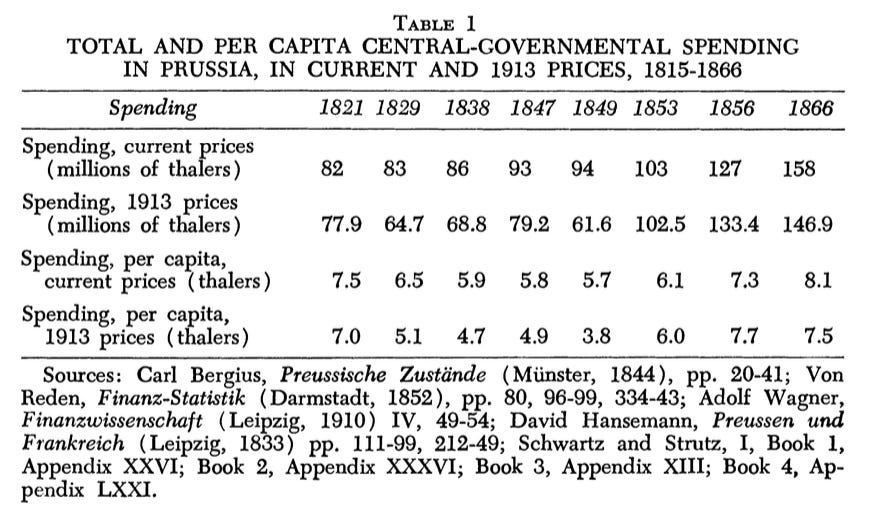
To illustrate, Tilly’s table shows that, in real terms, per capita revenue remained flat during the key years of Prussian industrialization.
By the 1970s, there were the beginnings of a pushback in the specialist literature about any distinctive German or Prussian path to modern economic development. In his overview of the Industrial Revolution in Germany, Knut Borchardt wrote in 1973:
“It is sometimes suggested that German governments pursued a policy of systematic industrialisation . . . that is at best an exaggeration for the period prior to 1850. The authorities were inclined rather to tolerate the evolution of industry; they took an interest in fostering the workers’ diligence and in safeguarding ‘the nourishment of the people,’ but their support for the tendency towards concentration was lukewarm . . . .” (Borchardt, 1973, p. 102)
The amount of money ever dedicated to industrial development, moreover, was small. And, as Tilly had argued, prior to the 1840s most elites had been quite hostile to industrialization, seeing it as a potentially revolutionary threat.
Nonetheless, the ellipsis in that quotation hides the one case Borchardt does see as an important example of industrial policy working, Silesia. So we should now turn to what historians have said about industrial policy in Silesia.
The Silesian Case Study
There is a general consensus that Silesia is the best example of the role of the Prussian state in industrial development. Economic development for military purposes had been prioritized in Silesia as soon as it had been acquired by Frederick the Great and there were state monopolies in timber and iron ore.
Clive Trebilock provides a good summary of the thesis that Silesia offers a case study in successful state-led modernization. In lines that would inspire Chang (who cites him), he describes the state taking an:
“entrepreneurial function upon itself, providing management, capital, and, critically important, technical skill to mould Silesia’s scattered mineral deposits into viable industrial concentrations” (Trebilock, 1981, p. 27)
In particular, under the leadership of Graf von Reden between 1780 and 1800, Silesia saw very rapid growth, with the industrial labor force increasing fivefold.
Nonetheless, Trebilock provides several caveats. First, he notes that while state direction was apparently successful in Silesia, it failed in similar cases in Saxony and Thuringia. Moreover, he notes:
“much of the Silesian growth followed from an exercise in entrepreneurial substitution, [while] it is worth noting that this device was applied only to a very limited range of military-related industries” (Trebilock, 1981, pp. 28–29)
The Silesian case was an isolated example of apparently successful top-down direction of industry. It did not have spillover effects; rather, it was limited in geographical scope.
“It is not true, therefore, that Prussian economic activity witnessed the triumph of state entrepreneurship over backwardness and an adverse value system; it rather saw state entrepreneurship confining itself to economic areas of especial interest to the Crown’s policies for internal security and external advantage.” (Trebilock, 1981, p. 29)
The decisive blow to Henderson’s argument and the myth of state-led industrialization in Prussia, however, would come from Eric Dorn Brose in his book The Politics of Technological Change in Prussia.
The Politics of Technological Change in Prussia
Building on a wider body of German-language scholarship, Brose looked at how state-backed Prussian industries actually functioned on the ground rather than buying into the self-serving mythology put out by the bureaucrats themselves.
From a detailed study of men like Peter Beuth, Brose shows that the attitude of the Prussian state towards industrialization was complex and governed by feuds between branches of government. There were many in the Prussian government who were influenced by economic liberalism and criticized state involvement in industry. Policy goals were always conflicting, and the actual picture of Prussian government policy was far more nuanced than Henderson or others had indicated.
Turning to the Silesian example, Brose shows that the entrepreneurial bureaucrats celebrated by Henderson and Chang were largely traditionalists in their outlook.
Recall Chang’s portrait:
“The most important of these was probably Graf von Reden, who successfully introduced advanced technologies from the more developed countries, especially Britain (from which he drew iron-puddling technology, the coke furnace and steam engine), by means of a combination of state-supported industrial espionage and the poaching of skilled workers during the late eighteenth and early nineteenth centuries” (Chang, 2002, p. 34).
Brose, in contrast, found from Reden’s own writings that his self-declared philosophy was historical and inspired by classical models. Indeed, Reden and his contemporaries had a military and backward-looking rather than entrepreneurial perspective. Their goal was to restore Silesian mining to what they saw as its earlier peak of performance before the Thirty Years’ War.
“Two of Reden’s greatest successes in Silesia were to substitute the blast furnace—a sixteenth-century technology—for simpler hearth and hammer techniques …, and to reopen the lead and silver mines of Tarnowitz, abandoned since the 1500s. … the young Alexander von Humboldt was dismayed to learn a few years later that Reden’s futuristic vision was essentially a mirror image of the past. Science had little to offer the Corps, Reden said, for ‘in technical matters we must adhere to the old ways.’” (Brose, 1992, p. 136)
Reden and his contemporaries had a state-centric and static view of the economy. Once they had achieved their goal of restoring output, they thought that further expansion of production would be self-defeating as it would glut the market.
“Reporting to Berlin about the intentions of private ironmakers to build new furnaces in 1832, for instance, a Corps metallurgist in Silesia wrote: ‘I fear there will be too many of these.’ Mining experts expressed similar concerns about markets, prices, and revenues. In their case, caution was reinforced by the traditional technique of hillside tunnel-mining (see below), a practice which rarely exposed the vaster quantities of mineral deposits far below the earth’s surface—or even knowledge of them. To Corps members unaware of these coal resources, a rapid pace of long-term growth seemed an inexcusable plundering of nature and an irresponsible mortgaging of future state income.” (Brose, 1992, p. 137)
It is perhaps unsurprising, then, that despite all of the activity, there was little to show for it. As Trebilock acknowledged, there was little in the way of positive spillovers to other industries or parts of Prussia. The notion of “demonstration” effects as envisioned by Chang and other champions of industrial policy seems speculative at best.
Brose, in his conclusion, is unsparing:
“The direct contribution of the state to investment seems even less if we employ ‘counterfactual’ analysis—that is, if we take a look at ‘hypothetical alternatives.’ Obviously there is no way to determine how much private investment was thwarted by state policies, but collectively they probably took a huge toll. Investors waited for over two years (1835–1837/38), for instance, while the Prussian bureaucracy fought over railroad policy. The postponed construction of 470 kilometers of line cost the nation at least 10 million thaler for every year of the delay, annually exceeding the likely amount of state investment by 7–8 million. It is also reasonable to blame the antirailroad laws of 1844 for a large share of that year’s 9.16 million thaler shortfall in purchases of railroad stocks over the previous year . . . And there are other significant examples. Army secrecy; the competition of state enterprises; and throttling mining and monetary policies accounted for additional millions which were lost. Perhaps on balance the state’s investment contribution was still a positive one, but we would do well not to exaggerate the net gain.” (Brose, 1992, p. 243)
The State and Economic Growth in Germany After 1850
The biggest problem with seeing Prussia as pursuing a unique state-led path of economic development is that the period of heavy state involvement in industry was between 1780 and 1840, but the period of rapid economic growth in Germany was after 1850.
This leads Chang into some bizarre claims. Challenged by the fact that German industrial growth took place in a period when state involvement in industry was fairly minimal he writes:
“During the Second Reich (1870–1914), further development of the private sector and the strengthening of the Junker element, which was opposed to further industrial development, in the bureaucracy, led to an erosion of state autonomy and capacity . . . . Despite the relative decline in state capacity and involvement in industrial development during this period, however, the importance of tariff policy and cartel policy for the development of heavy industries at the time should not be underestimated” (Chang, 2002, p. 35).
This feels like grasping at straws, and it is a misuse of the term state capacity which Noel Johnson and I make clear is not simply how big or involved in the economy the state is.
Now, there were important state investments that did have a payoff after 1850. The most important of these was in education and training. As I will discuss in Part 4, the role of the state in laying the foundations for Germany’s later lead in skilled apprenticeships and scientific and engineering training is well established.
But the idea of a distinct German path that featured heavy state direction has not survived scrutiny.
On X, Tiago Santos directed me to the work of Colleen Dunlavy. Dunlavy and Welskopp note that the correct comparator for late 19th-century Germany was the United States.
“For the United States as well as Germany, the first round of industrial growth in the middle decades of the nineteenth century was, not surprisingly, centered elsewhere—in railroad construction (with a good deal of British iron), in the machine-tool industry (which produced the machines used in manufacturing), and in hard-coal mining (principally in Pennsylvania and the Ruhr region).” (Dunlavy and Welskopp, 2007, p. 56)
Germany and the United States thus offer mirror images of one another, with the United States far less dominated by laissez-faire than portrayed in conventional accounts, and Germany much less reliant on state direction.
Where does this leave us? None of this means the Prussian state was irrelevant to German industrialization, only that there probably wasn’t a distinctive Prussian or German path to modern economic growth. Its real contribution was not that of an entrepreneur picking winners. The goal in Part 4, is to focus on the role of state capacity building and pro-market reforms, including the abolition of feudal privileges and guild restrictions, as well as the state’s role in education and technical training.
You keep making different arguments than the ones you say you're making. You haven't refuted the propositions that Prussia was absolutist or an example of state-led industrialization at all. You've merely found that Prussian Absolutism approximated the rule of law (but only for a while), and that Prussia's state-led industrialization wasn't deserving of that much credit for Prussia's economic success. Both are true, but what you claimed is that Prussia wasn't absolutist or an example of state-led industrialization, both of which are false. I address this in two essays:
https://freemarketsandfirepower.substack.com/p/dr-jekyll-and-mr-bismarck-the-split
https://freemarketsandfirepower.substack.com/p/how-frederick-the-great-made-the?utm_source=publication-search
E.g., the recovery of production methods from prior to the Thirty Years' War was actually a great improvement for Prussia at the time (even though those production methods were backwards compared to Britain), and the Prussian conquest of Silesia from Austria was done to capture strategic economic production for Prussia, which had developed because Austria had greater separation of Church and State than Prussia, which allowed for greater economic freedom.
Prussian state send the first steam engine to my hometown. No one had any real use of it. For a while it pumped water.
Years later some young entrepreneur opened a first small textile factory. And seeing its success the rich textile traders in town got together and founded what was to become the biggest linen weaving factory on the continent. In sum: it was indeed very helpful that the Prussian state did not object to industrialisation. ;)